 Gender Reassignment
How Age, DHT & Genetics Interact to Predict Hair Transplant
Introduction
Hair transplantation has become one of the most effective long-term solutions for restoring hair affected by androgenetic alopecia, commonly known as male or female pattern hair loss. Modern procedures such as Follicular Unit Extraction (FUE), Bio FUE, and advanced graft implantation techniques can produce highly natural, permanent results. However, one of the most common misconceptions is that every patient will achieve identical outcomes simply by undergoing surgery. In reality, the success of a hair transplant depends on several biological factors that continue to influence the scalp long after the procedure is completed.
Three of the most important factors are age, dihydrotestosterone (DHT), and genetics. These elements interact continuously throughout a person's life, determining when hair loss begins, how quickly it progresses, which follicles remain healthy, and how stable the donor area is over time. Understanding this relationship allows both patients and surgeons to make informed decisions regarding the timing of surgery, graft planning, medical therapy, and long-term expectations.
Hair transplantation does not stop the biological process responsible for androgenetic alopecia. Instead, it redistributes genetically resistant hair follicles from the donor region to areas affected by hair loss. Native hair surrounding the transplanted grafts may continue to thin if the underlying condition progresses. This is why evaluating future hair loss risk is just as important as assessing the current pattern of baldness.
At Hair & Shape Clinic, every hair transplant candidate undergoes a comprehensive assessment that extends beyond the visible bald area. Age, family history, scalp examination, donor density, hair characteristics, medical history, and the likelihood of future progression are carefully evaluated before recommending surgery. Our objective is to create a restoration plan that not only addresses current hair loss but also remains balanced and natural for many years to come.
Why Predicting Future Hair Loss Matters
A successful hair transplant is not judged only by the appearance immediately after surgery or even one year later. The true measure of success is whether the hairline and overall density continue to look natural as the patient ages.
Hair loss is often progressive.
If surgery is performed without considering future changes, patients may experience:
Continued thinning behind the transplanted hairline.
An unnatural appearance as surrounding native hair is lost.
Increased demand for additional transplant procedures.
Reduced availability of donor grafts for future restoration.
Long-term planning helps preserve donor resources while creating a hairline that continues to look appropriate throughout the ageing process.
Understanding the Biology of Hair Loss
Each hair follicle follows a continuous growth cycle consisting of three major phases.
Anagen Phase
This is the active growth stage during which the hair shaft is continuously produced.
Healthy scalp hair remains in anagen for several years.
Catagen Phase
A short transitional period during which the follicle gradually stops producing new hair.
Telogen Phase
The resting stage ends with the natural shedding of the hair before a new growth cycle begins.
In androgenetic alopecia, DHT gradually shortens the anagen phase while increasing follicular miniaturization.
As a result:
Hair becomes thinner.
Hair grows more slowly.
Follicles produce finer hairs.
Some follicles eventually stop producing visible hair altogether.
This biological process continues unless appropriately managed.
What Is DHT?
Dihydrotestosterone (DHT) is a naturally occurring androgen hormone produced when the enzyme 5-alpha reductase converts testosterone into its more biologically active form.
Although DHT plays an important role in normal male development, it is also the primary hormone responsible for androgenetic alopecia in genetically susceptible individuals.
DHT itself is not harmful.
The problem arises when genetically sensitive hair follicles respond excessively to its presence.
Over time, this sensitivity leads to:
Progressive follicle miniaturization.
Shorter hair growth cycles.
Reduced hair diameter.
Increased shedding.
Permanent follicle inactivity in advanced stages.
Not all scalp follicles respond equally to DHT, which explains why certain regions lose hair while others remain relatively unaffected.
Why Are Donor Hair Follicles Different?
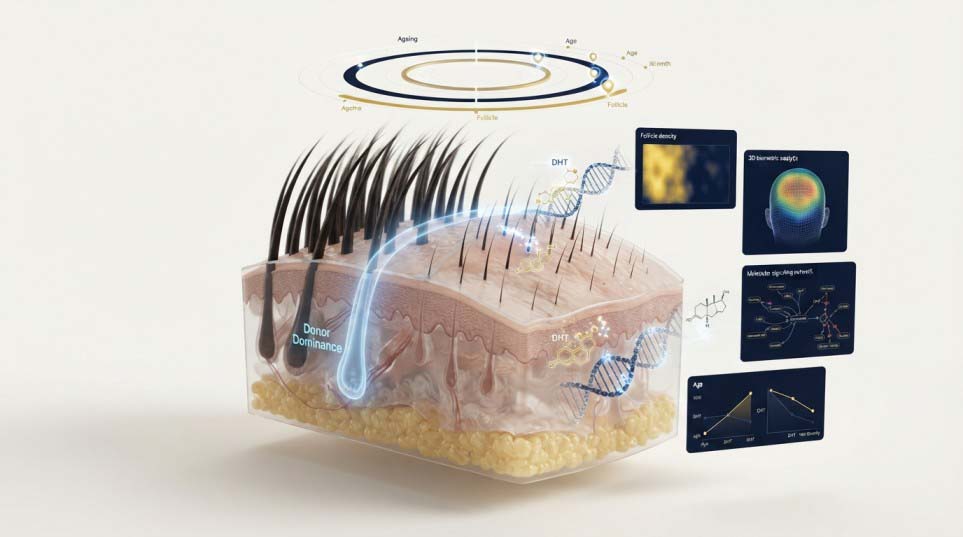
One of the fundamental principles behind modern hair transplantation is donor dominance.
Hair follicles located in the occipital scalp and portions of the parietal scalp are genetically more resistant to DHT than follicles located along the frontal hairline and crown.
Because of this biological resistance:
Donor follicles usually maintain long-term growth.
They continue producing healthy hair after transplantation.
They retain many of their original genetic characteristics in the recipient area.
This unique behaviour allows transplanted follicles to provide durable hair restoration for appropriately selected patients.
The Role of Genetics in Hair Loss
Genetics influence nearly every aspect of androgenetic alopecia.
Inherited factors determine:
Age of onset.
Pattern of baldness.
Rate of progression.
Degree of follicle sensitivity to DHT.
Donor area stability.
Hair density.
Hair shaft diameter.
Curl pattern.
Hair colour.
Hair loss is considered a polygenic condition, meaning multiple genes contribute to its development rather than a single inherited trait.
This explains why two individuals within the same family may experience very different patterns and severity of hair loss.
Does Family History Predict Hair Transplant Success?
Family history provides valuable information but should never be used in isolation.
During consultation, surgeons often ask about:
Father's hair loss.
Mother's family history.
Brothers.
Maternal uncles.
Grandparents.
A strong family history of advanced androgenetic alopecia may suggest a higher likelihood of future progression.
However, environmental factors, lifestyle, hormonal influences, and individual genetics also affect how hair loss develops.
Comprehensive clinical evaluation remains more accurate than relying solely on family history.
How Age Influences Hair Transplant Planning
Age is one of the most important considerations when planning hair restoration.
Younger patients often present with early-stage hair loss that may continue progressing over several decades.
Older individuals generally have a more established pattern of hair loss, making long-term planning more predictable.
Neither younger nor older age automatically makes someone a better candidate.
Instead, surgeons evaluate biological maturity of the hair loss pattern rather than chronological age alone.
Hair Transplants in Younger Patients
Patients in their early twenties frequently seek hair transplantation after noticing a receding hairline or thinning crown.
Although surgery may sometimes be appropriate, careful planning is essential.
Potential concerns include:
Ongoing Hair Loss
Native hair may continue thinning after surgery.
Changing Hairline Position
An aggressive youthful hairline may appear unnatural later in life.
Donor Conservation
Using excessive grafts too early may reduce options for future procedures.
Medical Therapy
Many younger patients benefit from medical treatment to stabilize hair loss before surgery is considered.
Individual assessment helps determine whether immediate transplantation or continued observation provides the best long-term outcome.
Hair Transplants in Older Patients
Older patients often have a more stable pattern of androgenetic alopecia.
This allows surgeons to:
Better estimate future hair loss.
Design age-appropriate hairlines.
Allocate donor grafts more efficiently.
Produce balanced long-term density.
Overall health, scalp quality, donor availability, and medical fitness remain important regardless of age.
Can Hair Loss Continue After a Hair Transplant?
Yes.
A hair transplant restores hair to areas that have already thinned or become bald, but it does not stop the biological process responsible for androgenetic alopecia.
While transplanted follicles taken from the donor area are generally resistant to DHT, the surrounding native hair may continue to miniaturize if the underlying condition progresses.
This is why some patients notice thinning behind the transplanted hairline several years after surgery.
Long-term treatment plans often include medical therapies, regular follow-up, and lifestyle modifications to help preserve existing hair and maintain a balanced appearance.
How Surgeons Evaluate Long-Term Hair Loss Risk
Hair transplant planning involves predicting not only today's pattern of hair loss but also how the scalp may change over the next 10 to 30 years.
During consultation, several factors are evaluated together.
Age
Younger patients often have less predictable hair loss progression, while older patients usually demonstrate a more stable pattern.
Family History
The pattern of androgenetic alopecia among close relatives provides useful information regarding possible future progression.
Current Pattern of Hair Loss
The distribution of thinning, recession, and crown involvement helps estimate the likely direction of future hair loss.
Donor Area Quality
The surgeon evaluates:
Hair density.
Hair calibre.
Hair colour.
Curl pattern.
Donor stability.
Scalp laxity.
These characteristics influence both graft availability and cosmetic coverage.
Miniaturization Assessment
Magnified scalp examination helps identify follicles that have already begun shrinking due to DHT, even before obvious hair loss becomes visible.
This information supports more accurate long-term planning.
Why Conservative Hairline Design Produces Better Long-Term Results
Many patients request a low, dense hairline similar to the one they had as teenagers.
However, an aggressively youthful hairline may not remain natural as facial features mature and surrounding hair continues to change.
A conservative approach offers several advantages.
Better Facial Balance
The hairline remains proportionate as the face naturally ages.
Preservation of Donor Hair
Fewer grafts are required initially, leaving additional follicles available if future restoration becomes necessary.
Natural Appearance
Hairlines designed with age progression in mind often continue to appear appropriate decades after surgery.
The goal is not simply to recreate a youthful appearance but to produce a hairline that remains aesthetically pleasing throughout adulthood.
Does DHT Affect Transplanted Hair?
Transplanted follicles obtained from the permanent donor region generally retain their natural resistance to DHT after transplantation.
This phenomenon is known as donor dominance.
As a result:
Most transplanted follicles continue producing healthy hair.
Long-term survival rates are generally high when surgery is performed correctly.
The transplanted hair usually behaves similarly to the donor hair from which it originated.
However, no biological process is completely absolute.
Natural ageing, medical conditions, severe nutritional deficiencies, certain medications, inflammatory scalp diseases, or significant systemic illness may still influence overall hair quality over time.
Can Medical Therapy Improve Long-Term Hair Transplant Outcomes?
Medical treatment often complements hair transplantation rather than replacing it.
Depending on the patient's individual needs, the treating surgeon may recommend therapies aimed at helping preserve existing native hair.
These may include:
DHT-Modulating Medications
Certain prescription medications reduce the effects of DHT on genetically susceptible follicles.
Growth-Stimulating Therapies
Some treatments help prolong the hair growth cycle and support follicular activity.
Platelet-Rich Plasma (PRP)
PRP may be recommended in selected patients as part of an overall hair restoration strategy.
Lifestyle Optimization
Addressing nutritional deficiencies, managing stress, improving sleep, and maintaining scalp health all contribute to healthier hair growth.
Treatment recommendations vary according to each patient's age, pattern of hair loss, medical history, and long-term goals.
Can Genetic Testing Predict Hair Transplant Success?
Research into genetic testing for hair loss continues to evolve.
Although certain genetic markers have been associated with androgenetic alopecia, current genetic tests cannot accurately predict:
The exact age hair loss will begin.
The final pattern of baldness.
Future donor stability.
Long-term transplant outcomes.
Clinical examination remains significantly more reliable than genetic testing alone.
Comprehensive assessment by an experienced hair restoration surgeon continues to be the gold standard for treatment planning.
Common Myths About Age, DHT, and Genetics
Several misconceptions often lead patients to misunderstand their hair transplant prognosis.
Myth: Older Patients Always Get Better Results
Older patients may have more stable hair loss patterns, but donor quality, scalp characteristics, overall health, and surgical planning remain equally important.
Myth: Young Patients Should Never Have Hair Transplants
Some younger patients are excellent candidates when their hair loss pattern, donor supply, and long-term treatment plan are carefully evaluated.
Myth: DHT Completely Destroys Every Hair Follicle
Only genetically susceptible follicles are significantly affected by DHT.
Donor follicles are naturally more resistant.
Myth: Hair Transplants Cure Hair Loss
Hair transplantation redistributes healthy follicles but does not eliminate androgenetic alopecia.
Native hair may continue thinning over time.
Myth: Genetics Alone Determine Success
Genetics are important, but successful outcomes also depend on surgical expertise, donor quality, postoperative care, medical management, and realistic planning.
Why Choose Hair & Shape for Hair Restoration?
Successful hair restoration requires more than technical graft placement. It begins with understanding the biology of hair loss and developing a long-term strategy tailored to each individual. Age, genetics, donor stability, scalp characteristics, and the likelihood of future progression must all be considered before surgery is recommended.
At Hair & Shape Clinic, every patient undergoes a comprehensive hair and scalp assessment using evidence-based clinical evaluation. Donor density, follicular miniaturization, hair characteristics, family history, and long-term restoration goals are carefully analysed to develop a personalized treatment plan. Our focus is on creating natural-looking hairlines, preserving valuable donor grafts, and achieving results that continue to look balanced for years to come.
Final Thoughts
Age, DHT, and genetics are closely interconnected factors that influence both hair loss progression and the long-term success of hair transplantation. While DHT drives follicular miniaturization in genetically susceptible individuals, genetics determine how sensitive each follicle is to this hormone, and age influences how predictable future hair loss becomes. Understanding the interaction between these factors allows surgeons to design hair restoration plans that remain natural as patients continue to age.
The most successful hair transplants are not simply those that produce immediate density but those that continue to look harmonious many years later. Careful patient selection, conservative hairline design, thoughtful donor management, ongoing medical therapy when appropriate, and realistic long-term planning all contribute to durable, natural-looking outcomes.