 Gender Reassignment
Can Wearing a Helmet Cause Hair Loss?
Introduction
Whether you ride a motorcycle every day, cycle for fitness, or wear a hard hat at work, you've probably heard someone claim that wearing a helmet causes hair loss.
It is a widespread belief that prolonged helmet use can weaken hair roots, suffocate the scalp, increase sweating, or even lead to permanent baldness. Some people notice more hair shedding after removing their helmet and naturally assume that the helmet is responsible.
Fortunately, the science tells a different story.
In most cases, wearing a properly fitted helmet does not directly cause permanent hair loss. However, certain helmet-related factors, such as excessive friction, poor hygiene, prolonged sweating, or an improperly fitting helmet, may contribute to temporary scalp problems or make an existing hair condition more noticeable.
Understanding the relationship between helmets, scalp health, and the hair growth cycle can help separate common myths from medical facts. This article explains how hair follicles function, whether helmets can affect hair growth, and when hair shedding may indicate an underlying medical condition rather than the helmet itself.
Understanding How Hair Actually Grows
To understand whether helmets can cause hair loss, it is helpful to first understand how hair grows.
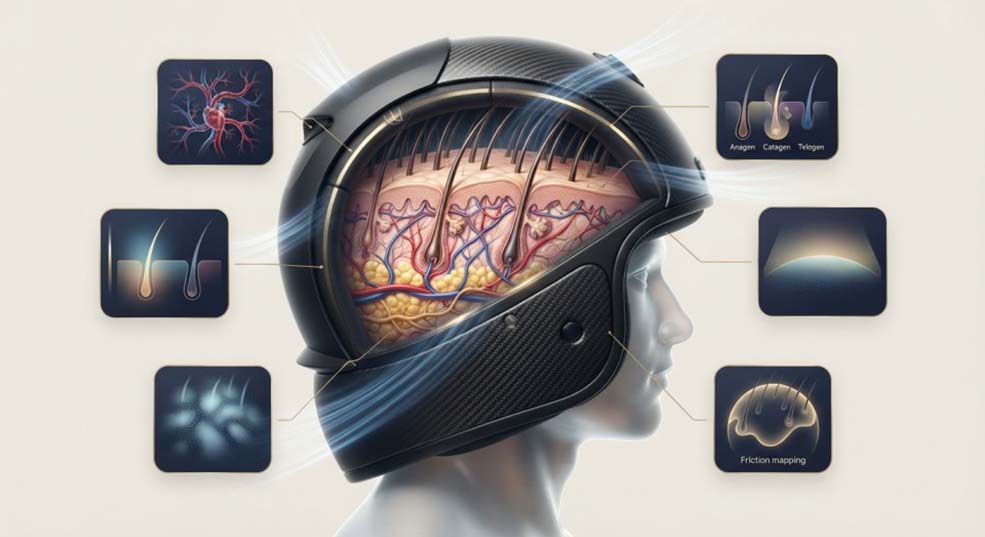
Each hair follicle is a tiny living organ located beneath the surface of the scalp. Every follicle follows a continuous cycle of growth, rest, shedding, and regeneration.
The three primary phases include:
Anagen (Growth Phase)
Active hair production
Lasts several years
Around 85–90% of scalp hairs are normally in this phase
Catagen (Transition Phase)
Hair growth slows
Follicle begins shrinking
Lasts a few weeks
Telogen (Resting Phase)
Hair remains in place before naturally shedding
New hair gradually replaces the old strand
A normal part of the hair cycle
Because hair growth occurs beneath the skin, external factors such as wearing a helmet usually do not interfere with the biological activity occurring inside healthy follicles.
The Common Myth: Helmets Suffocate Hair Follicles
One of the oldest misconceptions is that helmets prevent the scalp from "breathing."
In reality, hair follicles do not obtain oxygen directly from the surrounding air.
Instead, they receive oxygen and nutrients through an extensive network of blood vessels located beneath the scalp.
Hair follicles depend on:
Healthy blood circulation
Adequate nutrition
Hormonal balance
Cellular activity
Normal oxygen delivery through the bloodstream
Since follicles are nourished internally rather than externally, covering the scalp with a helmet does not deprive them of oxygen.
Can Helmets Reduce Blood Flow To The Scalp?
Some people worry that wearing a helmet compresses the scalp enough to reduce circulation.
For a properly fitted helmet, this is highly unlikely.
Modern helmets are designed to distribute pressure evenly across the head rather than concentrating force on isolated areas.
A correctly fitted helmet should:
Sit securely
Avoid excessive pressure points
Remain stable during movement
Provide even support
Normal helmet use does not significantly restrict the blood supply required for healthy hair growth.
Why Some People Notice Hair Shedding After Removing A Helmet
Finding loose hairs inside a helmet often causes concern.
However, this usually reflects the normal hair growth cycle rather than new hair loss.
Every day, healthy individuals naturally shed approximately 50 to 100 hairs as older strands complete the telogen phase.
When you remove a helmet, these already-detached hairs may become trapped inside the padding and appear more noticeable.
The helmet is revealing naturally shed hairs rather than causing them.
Can Friction Damage Hair?
Although helmets do not typically damage the follicles themselves, repeated friction may affect the hair shafts.
Hair shafts are the visible strands above the skin.
Excessive rubbing between the helmet lining and the hair may contribute to:
Hair breakage
Split ends
Increased tangling
Dryness
Frizz
Importantly, hair breakage differs from true hair loss because the follicle remains healthy and continues producing new hair.
Can Tight Helmets Cause Hair Loss?
An excessively tight helmet may place unnecessary pressure on certain parts of the scalp.
While occasional pressure is unlikely to damage healthy follicles, chronic mechanical stress over prolonged periods may contribute to localised scalp discomfort.
Potential issues include:
Pressure-related soreness
Skin irritation
Hair shaft breakage
Increased friction
Local discomfort
Selecting the correct helmet size helps minimise unnecessary pressure while maintaining appropriate safety standards.
What Is Traction Alopecia?
Traction alopecia is a form of hair loss caused by continuous pulling or tension on the hair.
It is most commonly associated with:
Tight ponytails
Braids
Hair extensions
Turbans
Certain occupational hairstyles
Helmets themselves rarely cause traction alopecia.
However, tightly securing long hair beneath a helmet every day may contribute to excessive tension if hairstyles pull continuously on the same follicles.
Changing hairstyles regularly and avoiding excessive tension can help reduce this risk.
Does Sweating Under A Helmet Cause Hair Loss?
Helmets naturally increase scalp temperature during physical activity.
As a result, sweating is common.
Sweat itself does not cause permanent hair loss.
However, excessive moisture combined with poor scalp hygiene may contribute to temporary scalp problems such as:
Itching
Irritation
Dandruff
Folliculitis
Seborrhoeic dermatitis
Maintaining good scalp hygiene helps minimise these issues while supporting overall scalp health.
Can Dirty Helmets Affect Scalp Health?
Helmet interiors gradually accumulate:
Sweat
Oil
Dead skin cells
Dust
Environmental debris
Microorganisms
If helmet liners are rarely cleaned, these materials may increase scalp irritation in susceptible individuals.
Although this does not directly cause permanent hair loss, chronic scalp inflammation may worsen existing scalp conditions that affect healthy hair growth.
Regular cleaning of removable helmet liners and allowing helmets to dry completely after use helps maintain better scalp hygiene.
Can Helmet Use Worsen Male Pattern Baldness?
Male pattern baldness, also known as androgenetic alopecia, is the most common cause of permanent hair loss in men.
It develops because genetically susceptible hair follicles become progressively sensitive to the hormone dihydrotestosterone (DHT). Over time, affected follicles shrink, producing finer, shorter hairs until growth eventually stops.
Helmet use does not increase DHT levels or accelerate this biological process.
However, because helmets flatten the hair, expose the scalp, and reduce hair volume temporarily, thinning areas may become more noticeable after removing the helmet. This can create the impression that the helmet is causing hair loss when, in reality, it is simply revealing an existing condition.
Can Helmets Affect Hair Transplant Results?
Patients who have recently undergone a hair transplant often ask when it is safe to wear a helmet again.
Immediately after surgery, newly transplanted grafts require time to become securely anchored within the scalp.
Wearing a helmet too early may:
Apply pressure to healing grafts
Increase friction
Cause discomfort
Interfere with early healing
The appropriate time to resume wearing a helmet depends on:
The surgical technique
The healing progress
The type of helmet
Your surgeon's postoperative instructions
Patients should always follow personalised advice before returning to motorcycle riding, cycling, or occupations requiring protective headgear.
Can Helmets Cause Permanent Hair Loss?
For most healthy individuals, the answer is no.
A well-fitted helmet worn for normal daily activities does not permanently damage healthy hair follicles.
Permanent hair loss is far more commonly associated with factors such as:
Genetics
Hormonal changes
Autoimmune conditions
Nutritional deficiencies
Certain medications
Medical illnesses
Chronic inflammatory scalp disorders
While helmet-related friction may occasionally cause temporary hair shaft breakage or scalp irritation, it does not destroy healthy follicles.
When Hair Loss Is Probably Not Related To Your Helmet
If hair shedding continues regardless of helmet use, another underlying cause may be responsible.
Medical evaluation is recommended if you notice:
Progressive thinning over several months
A widening part line
Receding hairline
Bald patches
Excessive daily shedding
Persistent scalp itching
Scalp redness
Pain or tenderness
Family history of pattern hair loss
Early assessment often allows appropriate treatment before significant hair loss occurs.
Tips For Protecting Your Hair While Wearing A Helmet
Although helmets do not directly cause permanent hair loss, simple habits can help maintain healthy hair and scalp.
Consider the following:
Choose the correct helmet size.
Keep the helmet lining clean.
Wash removable padding regularly.
Allow the helmet to dry after use.
Avoid excessively tight hairstyles beneath the helmet.
Wash the scalp regularly after heavy sweating.
Replace worn-out helmet liners when necessary.
Maintain a balanced diet that supports healthy hair growth.
These measures improve scalp comfort while reducing unnecessary friction and irritation.
Common Myths About Helmets And Hair Loss
Several misconceptions continue to circulate despite a lack of scientific evidence.
"Hair Needs Fresh Air To Grow"
Hair follicles receive oxygen through the bloodstream, not directly from the surrounding air.
"Sweat Kills Hair Follicles"
Sweat itself does not damage hair follicles. Poor hygiene, however, may contribute to scalp irritation if sweat is allowed to accumulate.
"Motorcycle Riders Always Go Bald"
There is no evidence that riding motorcycles or regularly wearing helmets increases the risk of permanent hair loss.
"A Tight Helmet Stops Hair Growth"
A properly fitted helmet should not restrict blood circulation enough to affect follicle function. Extremely tight or poorly fitted helmets may cause discomfort or hair shaft breakage but do not usually damage healthy follicles.
Why Choosing An Experienced Hair Specialist Matters
Hair loss can result from many different causes, and the correct treatment depends on identifying the underlying reason rather than assuming external factors such as helmet use are responsible.
A comprehensive hair assessment may include evaluation of:
Hair density
Scalp health
Pattern of hair loss
Medical history
Family history
Lifestyle factors
Nutritional status
Hormonal influences
An accurate diagnosis allows treatment to be tailored to the individual's specific condition, improving the likelihood of successful long-term outcomes.
Why Choose Hair & Shape For Hair Loss Treatment In Mumbai?
At Hair & Shape Clinic, every patient experiencing hair loss undergoes a thorough evaluation to identify the true cause before treatment is recommended. Rather than attributing hair thinning to common myths, the team assesses scalp health, hair density, family history, lifestyle, and medical factors to develop a personalised management plan.
Dr. Umang Kothari and the Hair & Shape team offer evidence-based solutions for a wide range of hair loss conditions, including androgenetic alopecia, diffuse hair thinning, and post-transplant care. By combining advanced diagnostic methods with customised treatment strategies, the focus remains on preserving existing hair, promoting healthy growth, and achieving natural-looking, long-term results.
Final Thoughts
Wearing a helmet is an essential safety measure and should not be avoided because of concerns about hair loss. Scientific evidence shows that a properly fitted helmet does not suffocate hair follicles, restrict blood supply, or directly cause permanent baldness. While prolonged friction, excessive sweating, poor helmet hygiene, or an improper fit may contribute to temporary hair shaft breakage or scalp irritation, these factors are very different from true hair loss originating within the hair follicle.
If you notice persistent thinning, increased shedding, or changes in your hairline, the cause is more likely to be an underlying hair or scalp condition rather than helmet use. A professional assessment can help identify the reason for hair loss and guide you towards the most appropriate treatment while allowing you to continue protecting yourself with properly fitted protective headgear.