Rhinoplasty (Nose Surgery) In Mumbai
Reshape and refine the nose for balanced, natural facial proportions.
Introduction
The nose is a central feature of the face, so even small differences in its bridge, tip, width, projection, or symmetry can influence overall facial balance. Rhinoplasty, commonly known as nose surgery, reshapes the underlying bone and cartilage to alter nasal form while preserving—or, when necessary, improving—its function.
The procedure can address concerns such as a prominent hump, broad or drooping tip, wide nostrils, nasal asymmetry, or disproportionate nose size. In patients with structural problems such as a deviated septum or nasal obstruction, surgery may also be planned to improve breathing.
Because the nose needs to remain in harmony with the chin, forehead, cheeks, and overall facial proportions, rhinoplasty requires detailed anatomical planning rather than simply making the nose smaller.
At Hair & Shape Clinic in Mumbai, facial aesthetic procedures are planned according to individual anatomy and long-term treatment goals. Dr. Umang Kothari, Founder and Director of the clinic and a Plastic, Cosmetic & Reconstructive Surgeon, has a clinical focus that includes facial aesthetics and reconstructive surgery.
Depending on the nasal structure and correction required, rhinoplasty may be performed using an open or closed approach, with cartilage reshaping or grafting used when additional structural support is needed.
The objective is not to create the same nose for every patient, but to achieve a natural-looking shape that complements the face while maintaining healthy nasal function.
What Is Rhinoplasty?
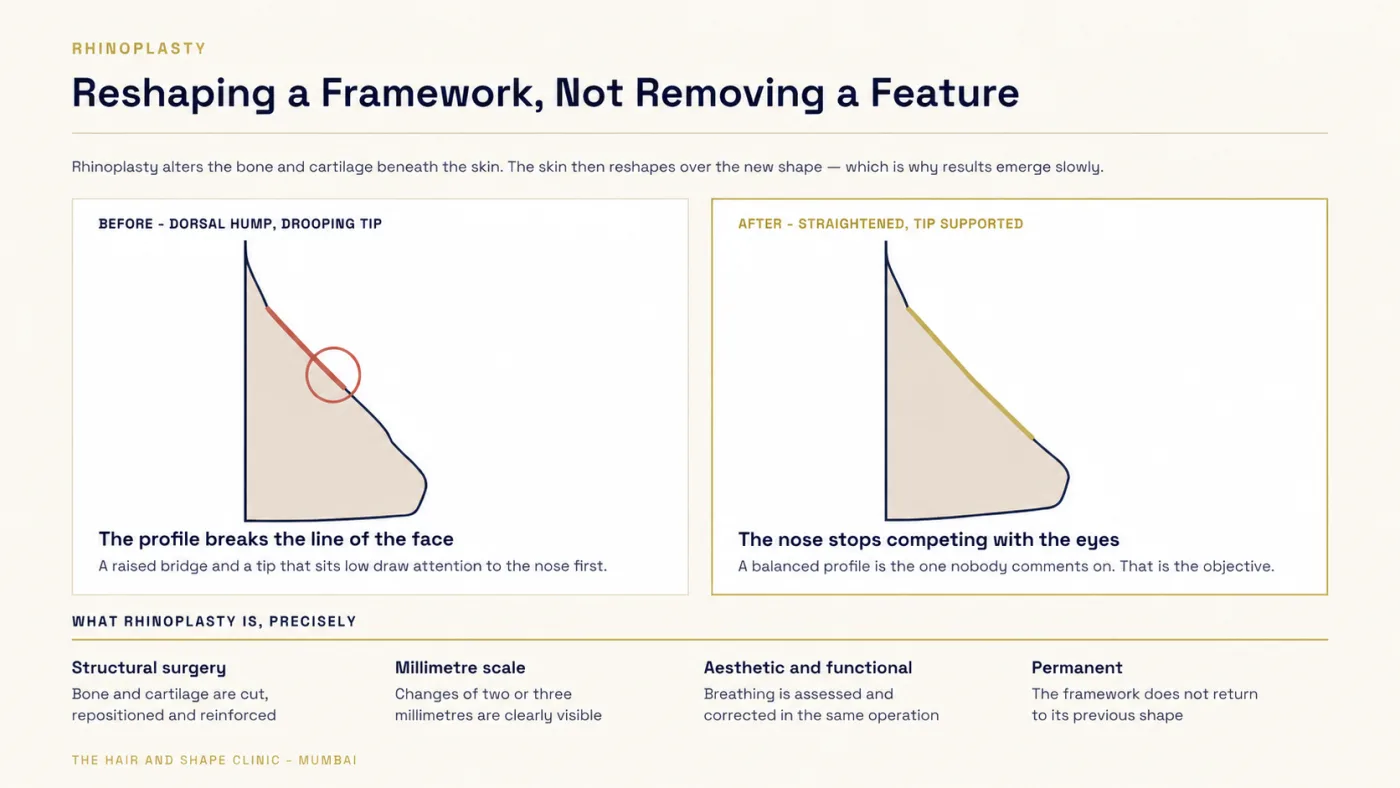
Rhinoplasty is a surgical procedure that reshapes the bones, cartilage, and soft tissues of the nose to improve its appearance, function, or both.
Depending on the patient's concerns, rhinoplasty may involve:
Reducing or increasing nasal size.
Refining the nasal tip.
Straightening a crooked nose.
Removing a dorsal hump.
Narrowing the nasal bridge.
Correcting asymmetry.
Improving breathing.
Repairing traumatic deformities.
Revising previous rhinoplasty.
Because the nose is a three-dimensional structure supported by delicate cartilage and bone, even small surgical changes can have a significant impact on both appearance and nasal function.
The objective is not to create a "perfect" nose but to achieve one that appears balanced, proportionate, and naturally suited to the rest of the face.
Understanding the Anatomy of the Nose
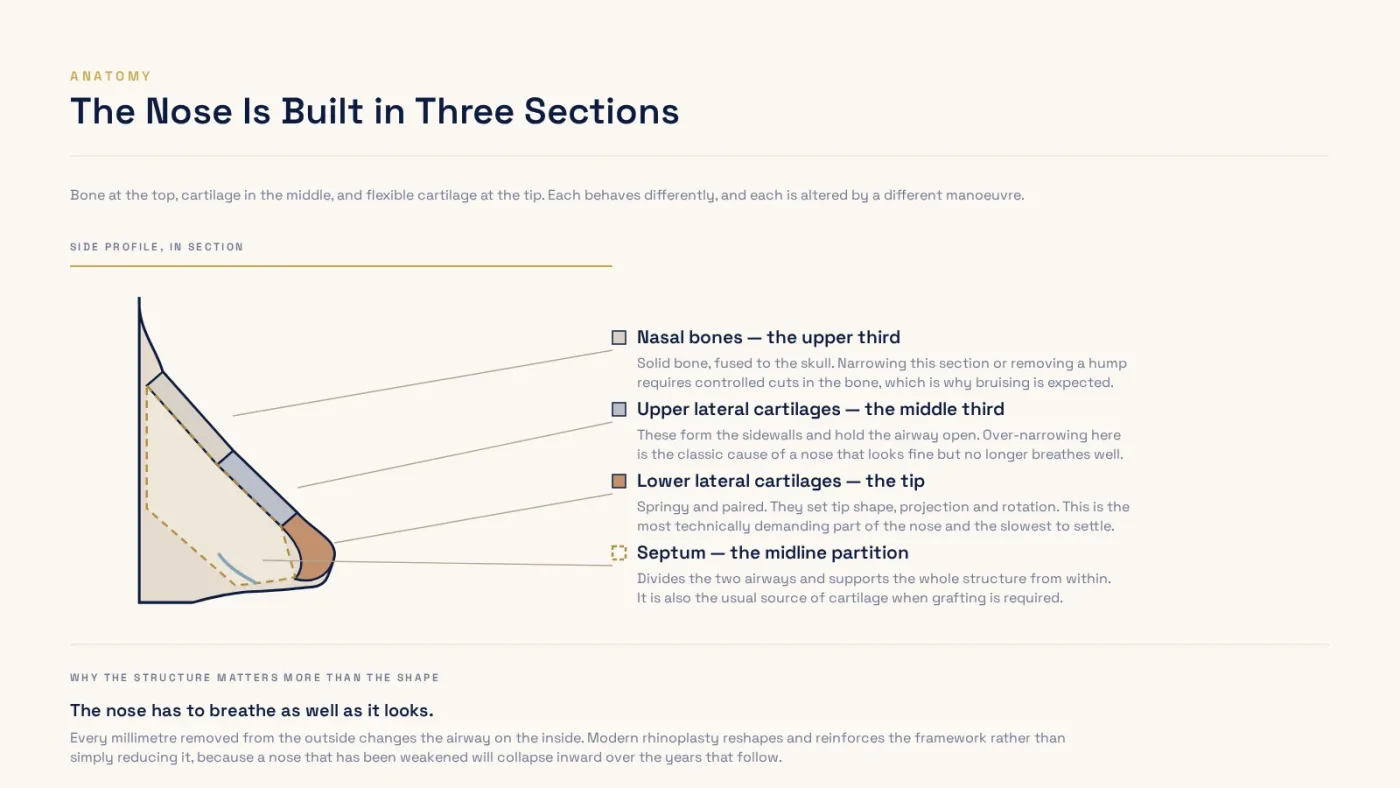
Successful rhinoplasty requires a detailed understanding of the complex anatomy of the nose.
The external appearance depends on several structural components working together.
Nasal Bones
The upper third of the nose is formed by paired nasal bones.
These determine:
Width of the bridge.
Height of the dorsum.
Overall upper nasal shape.
Upper Lateral Cartilages
Located beneath the nasal bones, these cartilages contribute to the middle portion of the nose and play an important role in maintaining airflow.
Lower Lateral Cartilages
These cartilages form the nasal tip and nostrils.
Their shape influences:
Tip definition.
Tip projection.
Tip rotation.
Nostril shape.
Nasal Septum
The septum is the wall separating the two nasal passages.
It provides structural support while maintaining airflow through both nostrils.
A deviated septum may contribute to breathing difficulties.
Nasal Skin
Skin thickness varies considerably among individuals.
Thin skin reveals even small structural changes, whereas thicker skin may limit the visibility of fine refinements.
Understanding each of these anatomical elements helps guide surgical planning while preserving long-term stability.
Why Do People Consider Rhinoplasty?
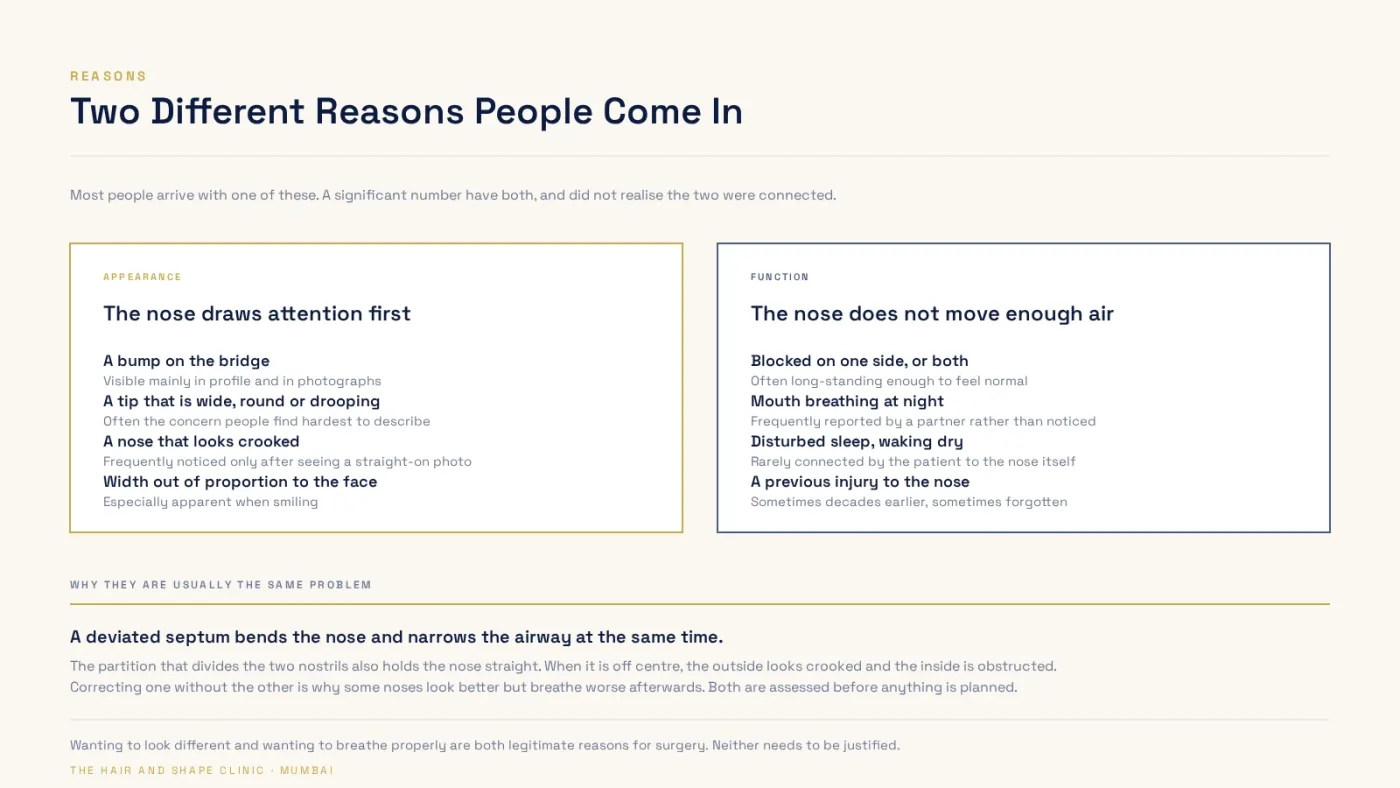
Patients choose rhinoplasty for many different reasons.
Some wish to improve facial proportions, while others seek functional correction or reconstruction following trauma.
Cosmetic Concerns
Common aesthetic concerns include:
Prominent dorsal hump.
Large nose.
Wide nasal bridge.
Bulbous nasal tip.
Drooping nasal tip.
Crooked nose.
Wide nostrils.
Facial imbalance.
Functional Concerns
Some patients experience structural problems that interfere with breathing.
Examples include:
Deviated nasal septum.
Nasal valve collapse.
Congenital deformities.
Previous nasal fractures.
Internal structural abnormalities.
Post-Traumatic Reconstruction
Injuries may alter both the appearance and function of the nose.
Rhinoplasty can restore damaged structures following facial trauma.
Revision Surgery
Some patients remain dissatisfied after previous rhinoplasty or experience functional problems requiring corrective surgery.
Revision rhinoplasty addresses both cosmetic and structural concerns whenever feasible.
How Does Rhinoplasty Improve Facial Harmony?
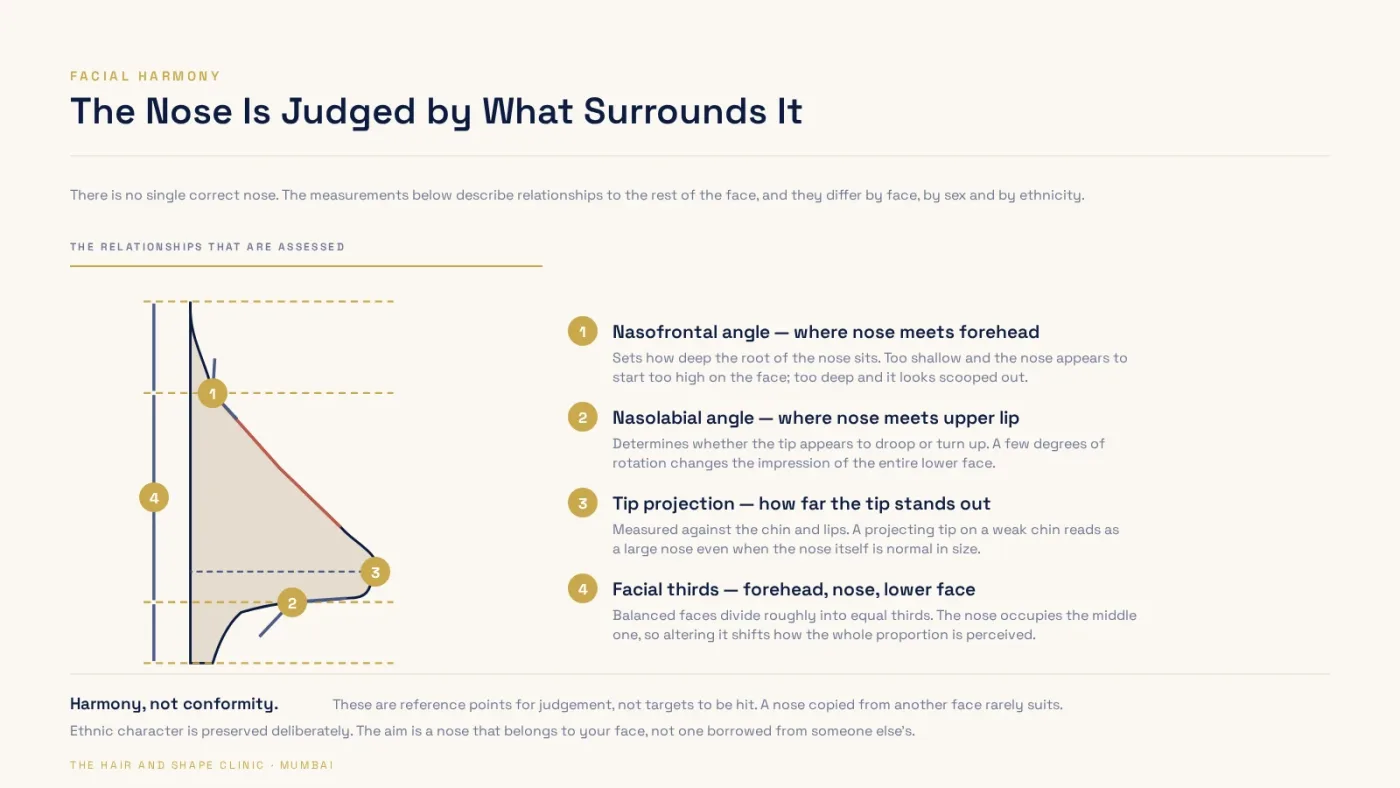
The nose influences nearly every facial angle and proportion.
Rather than focusing on the nose alone, modern rhinoplasty evaluates its relationship with surrounding facial structures.
Important considerations include:
Facial Proportions
The nose should remain proportional to:
Forehead.
Eyes.
Cheeks.
Lips.
Chin.
Jawline.
Facial Profile
Changes to nasal projection or bridge height influence side-profile balance.
Sometimes chin enhancement may also be discussed to optimize facial proportions.
Front View Symmetry
The bridge, tip, and nostrils should appear balanced while maintaining natural anatomical variation.
Nasolabial Angle
The angle between the upper lip and nose contributes significantly to overall facial aesthetics.
Nasofrontal Angle
The transition between the forehead and nasal bridge affects profile harmony.
Modern rhinoplasty aims to enhance these relationships rather than creating an isolated cosmetic change.
Who Is a Good Candidate for Rhinoplasty?
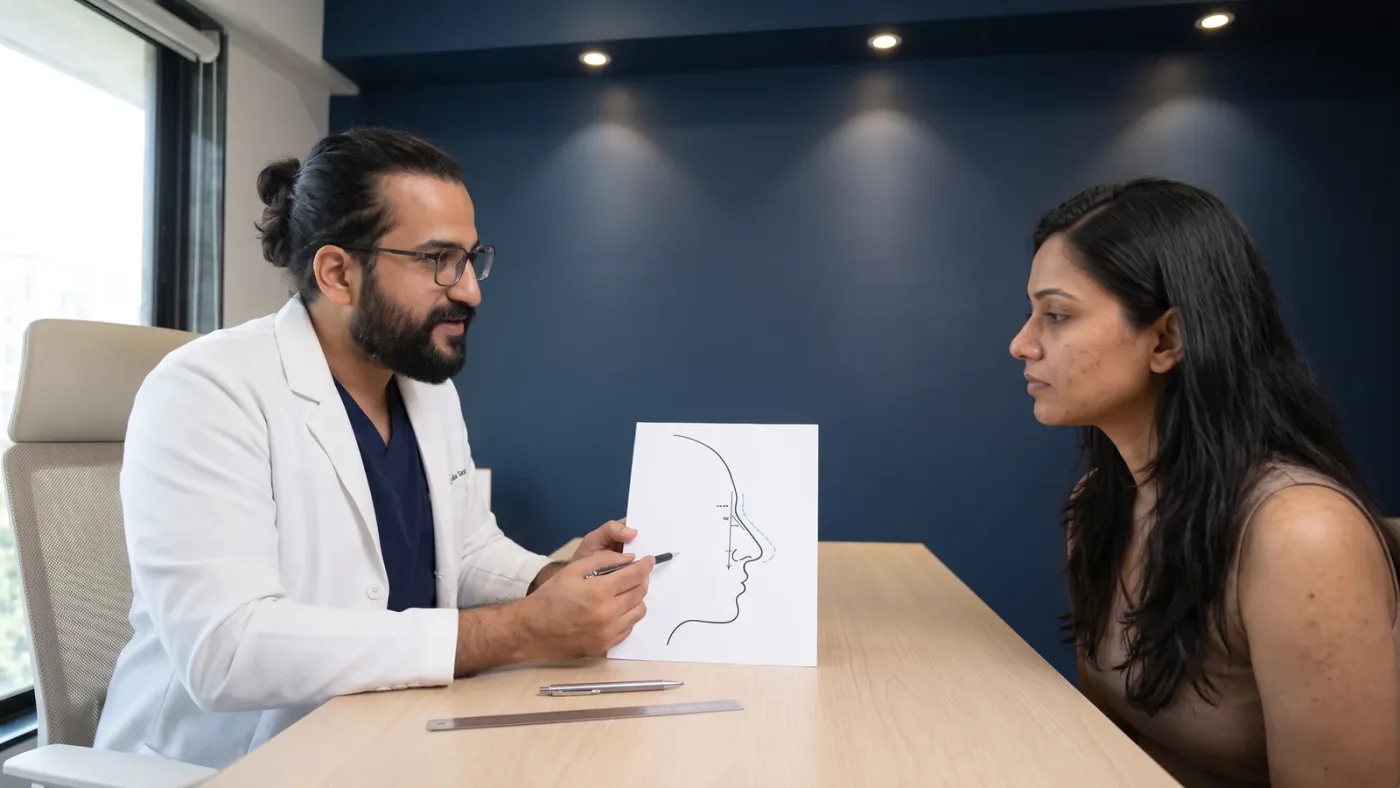
Rhinoplasty may be appropriate for individuals seeking cosmetic improvement, functional correction, or both.
You may be a suitable candidate if you:
Are bothered by the appearance of your nose.
Experience breathing difficulties caused by structural abnormalities.
Have completed facial growth.
Are physically healthy.
Do not smoke or are willing to stop during recovery.
Have realistic expectations.
Understand both the benefits and limitations of surgery.
A detailed consultation helps determine whether rhinoplasty is appropriate based on your anatomy, concerns, and treatment goals.
What Conditions Can Rhinoplasty Address?
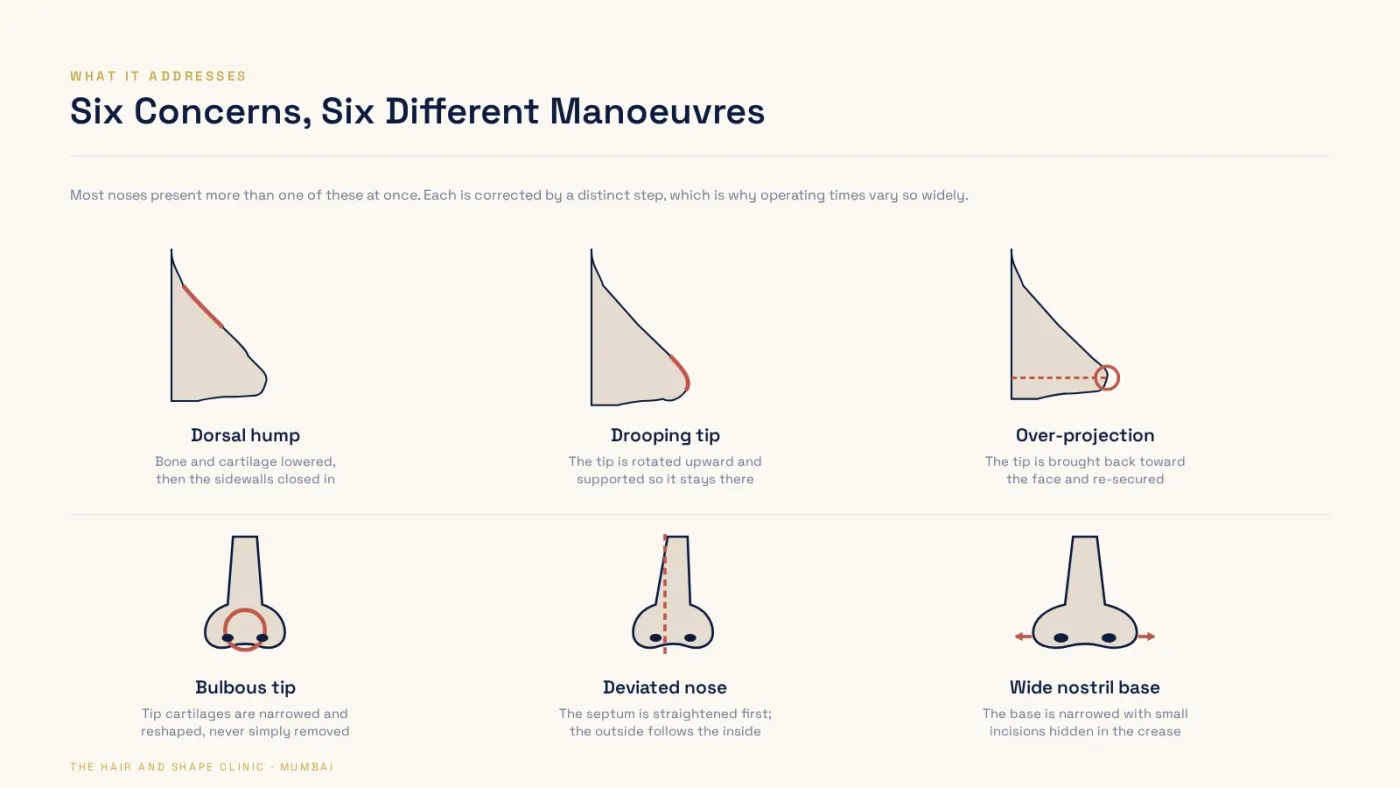
Rhinoplasty may be performed for a wide variety of cosmetic and functional concerns.
Dorsal Hump
Reduces the prominence of a bump along the nasal bridge.
Wide Nasal Bridge
Narrows the bridge to improve facial balance.
Bulbous Nasal Tip
Refines excessive tip width while preserving natural support.
Crooked Nose
Improves alignment caused by developmental asymmetry or previous injury.
Drooping Nasal Tip
Adjusts tip position to improve facial proportions.
Large Nose
Reshapes overall nasal dimensions while maintaining harmony with other facial features.
Deviated Septum
May be corrected simultaneously when functional breathing problems are present.
Post-Traumatic Nasal Deformities
Restores appearance and function following fractures or facial injuries.
Revision Rhinoplasty
Addresses cosmetic or functional concerns following previous nasal surgery.
Personalized Rhinoplasty Planning
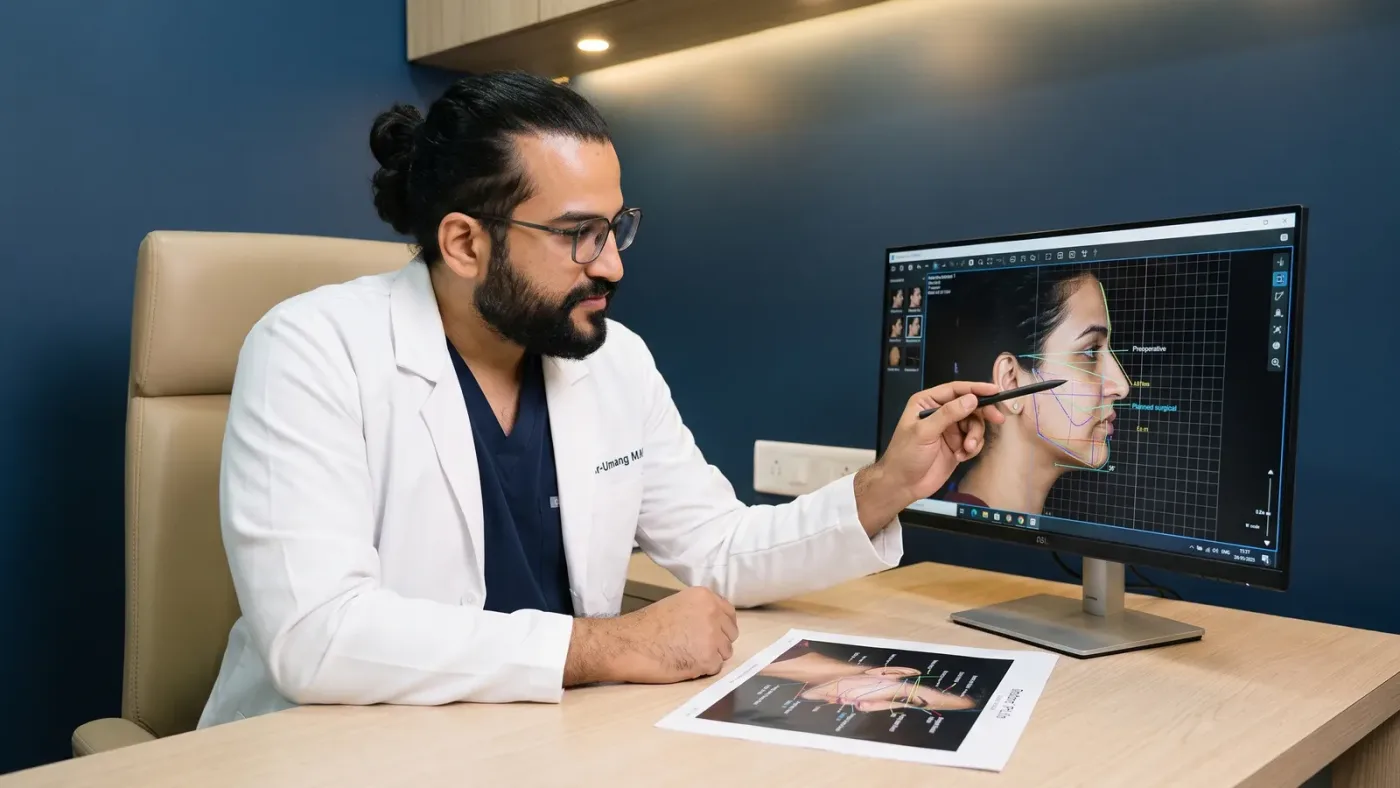
No two noses are identical, and no single rhinoplasty technique is suitable for every patient. Successful surgery begins with a detailed evaluation of the entire face rather than the nose alone. Factors such as facial proportions, skin thickness, cartilage strength, nasal symmetry, breathing function, ethnic background, and individual aesthetic preferences all influence the surgical plan.
At Hair & Shape Clinic, consultation includes a comprehensive assessment of both cosmetic and functional concerns. The goal is to understand what aspects of the nose concern you, evaluate how those concerns relate to the rest of your facial anatomy, and develop a surgical approach that produces natural, balanced, and long-lasting results while preserving normal nasal function.
Rather than creating a standardized nose shape, treatment is tailored to enhance each patient's unique facial characteristics.
What Happens During Rhinoplasty Surgery?
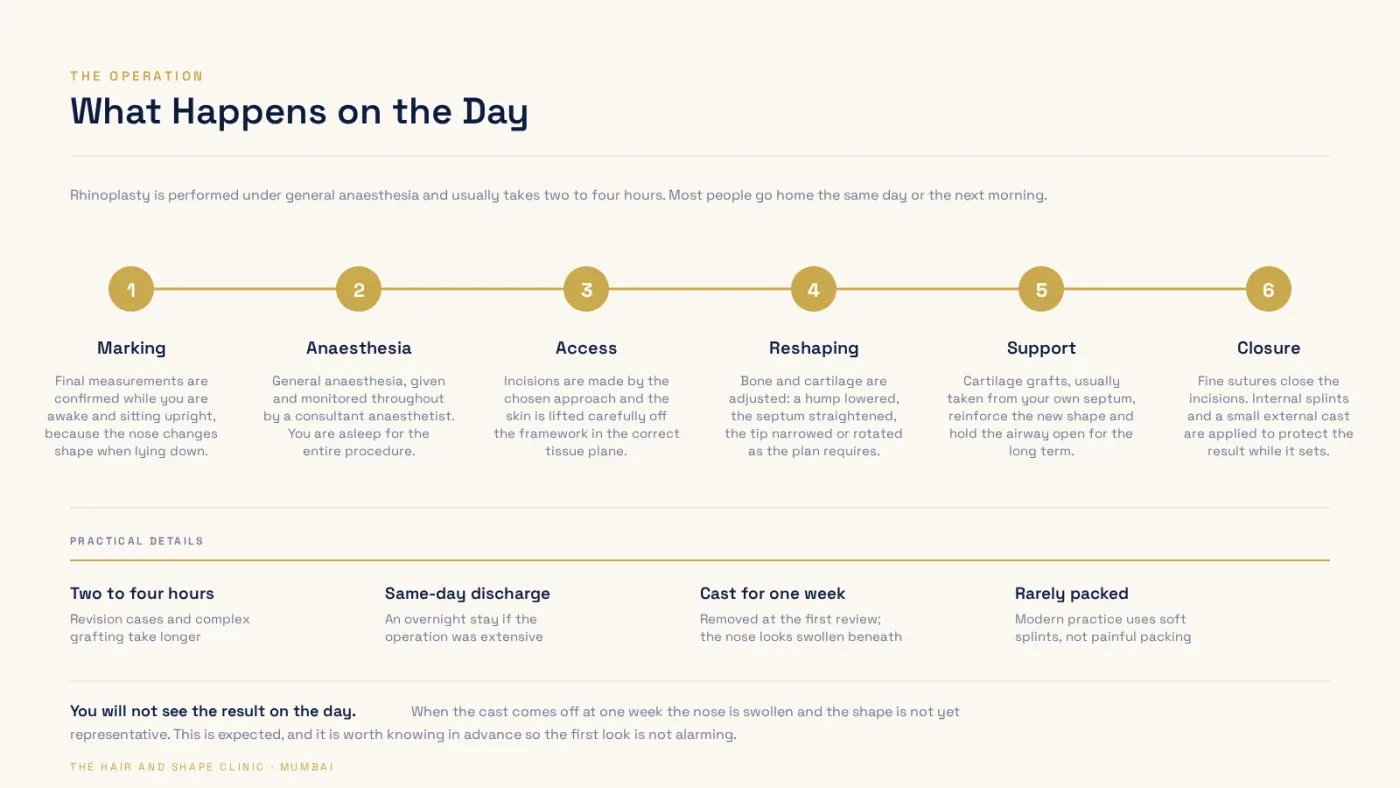
Rhinoplasty is performed in an accredited operating facility under carefully controlled sterile conditions. Depending on the complexity of the procedure and the surgical plan, the operation usually takes between two and four hours.
The exact surgical technique varies from patient to patient because every nose has unique anatomy and every individual has different aesthetic and functional goals.
A typical rhinoplasty procedure includes the following stages.
Step 1: Preoperative Planning
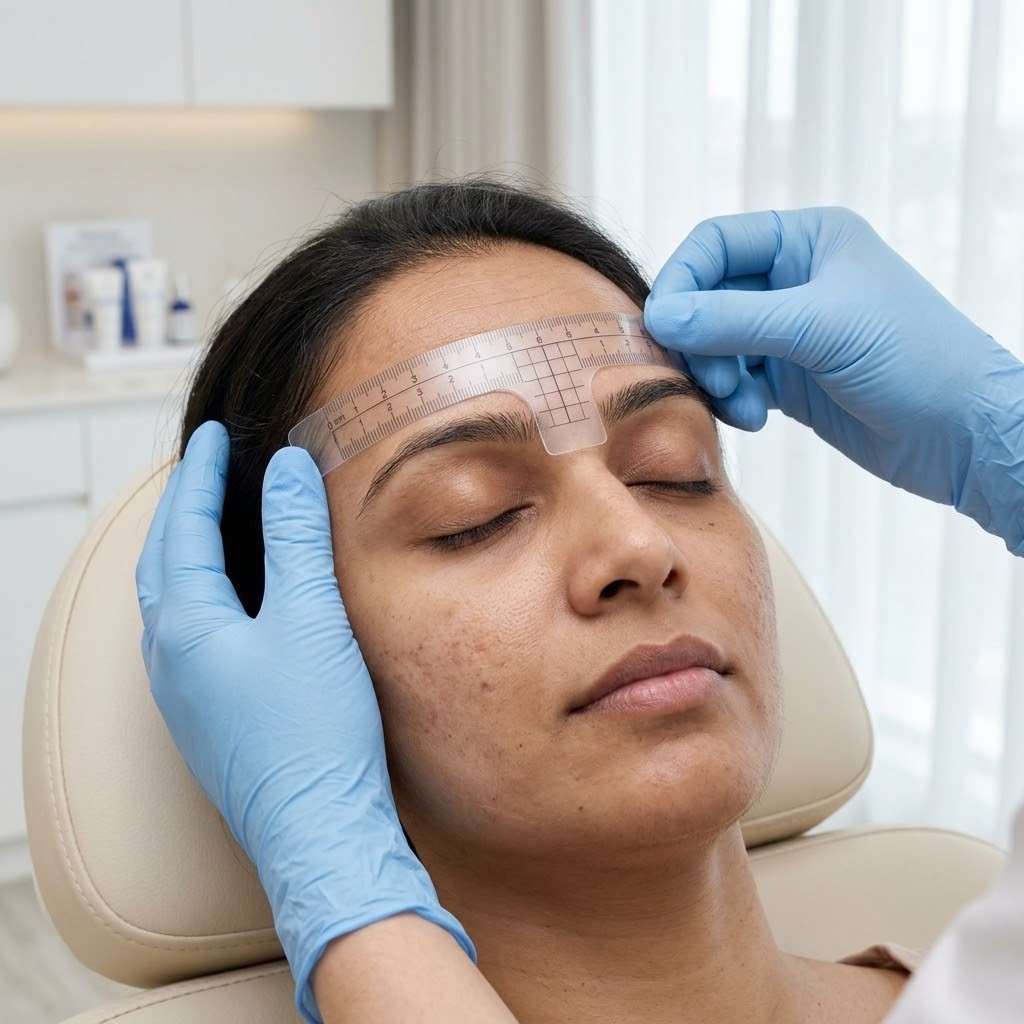
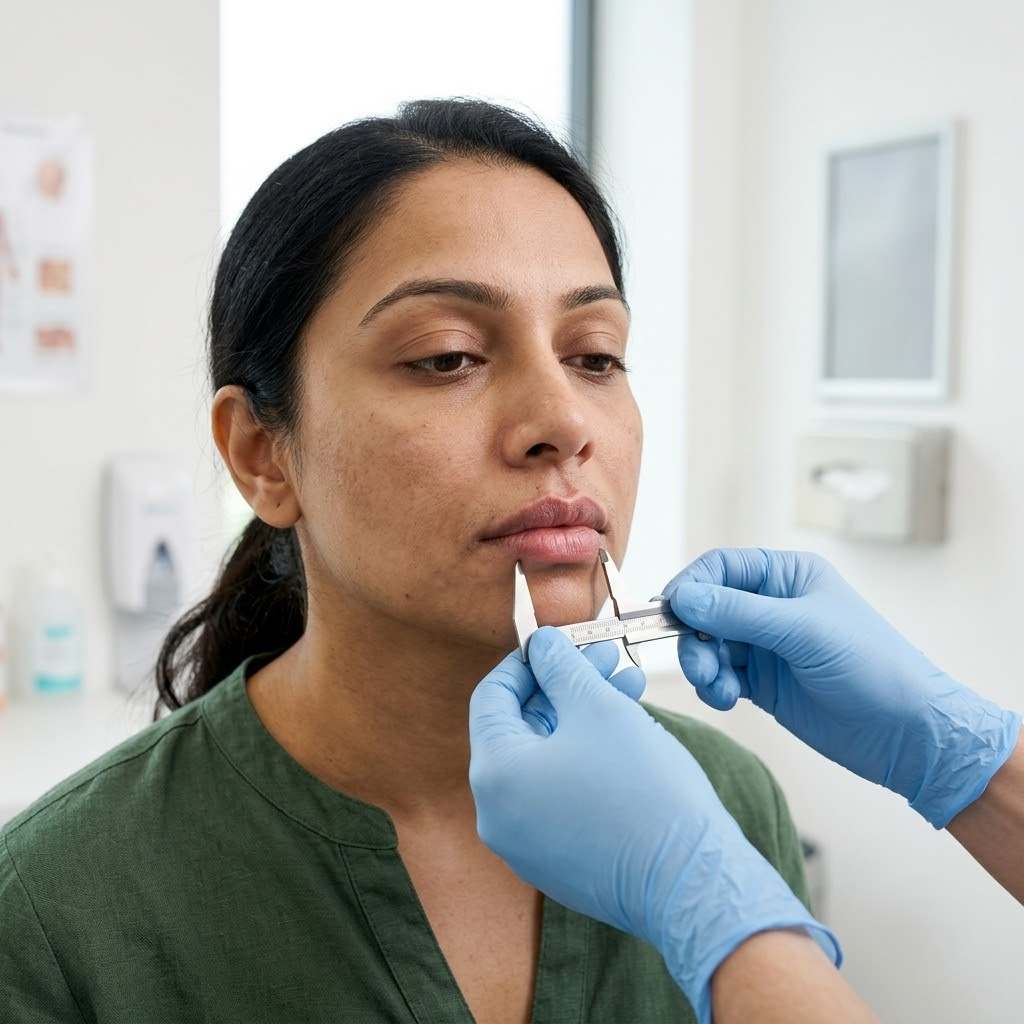
Before surgery begins, your surgeon carefully reviews the treatment plan developed during consultation.
This includes:
Facial analysis.
Nasal measurements.
Surgical markings.
Review of aesthetic goals.
Assessment of breathing function.
Confirmation of planned structural modifications.
Every surgical decision is guided by the goal of improving facial harmony while maintaining or enhancing nasal function.
Step 2: Anaesthesia
Rhinoplasty is usually performed under general anaesthesia, allowing the procedure to be completed safely and comfortably.
Throughout surgery, your vital signs are continuously monitored by the anaesthesia team.
Step 3: Surgical Approach
Your surgeon performs rhinoplasty using either an open or closed technique.
Open Rhinoplasty
A small incision is placed across the columella, the narrow strip of skin between the nostrils.
This allows the nasal skin to be gently elevated, providing complete visibility of the underlying bone and cartilage.
Open rhinoplasty is commonly used for:
Complex reshaping.
Tip refinement.
Revision rhinoplasty.
Significant structural reconstruction.
Closed Rhinoplasty
All incisions are placed inside the nostrils.
There are no visible external scars.
Closed rhinoplasty may be appropriate for selected patients requiring less extensive structural modification.
The choice of approach depends entirely on the patient's anatomy and surgical objectives.
Step 4: Structural Reshaping
After accessing the nasal framework, the surgeon reshapes the underlying structures.
Depending on the treatment plan, this may include:
Refining cartilage.
Reshaping nasal bones.
Reducing a dorsal hump.
Straightening the septum.
Narrowing the bridge.
Refining the nasal tip.
Correcting asymmetry.
Improving nasal airflow.
Every modification is performed conservatively to preserve both structural stability and long-term nasal function.
Step 5: Closure
Once the desired changes have been completed, the skin is repositioned carefully.
Incisions are closed using fine sutures.
An external nasal splint is usually applied to help support the healing tissues during the initial recovery period.
Types of Rhinoplasty
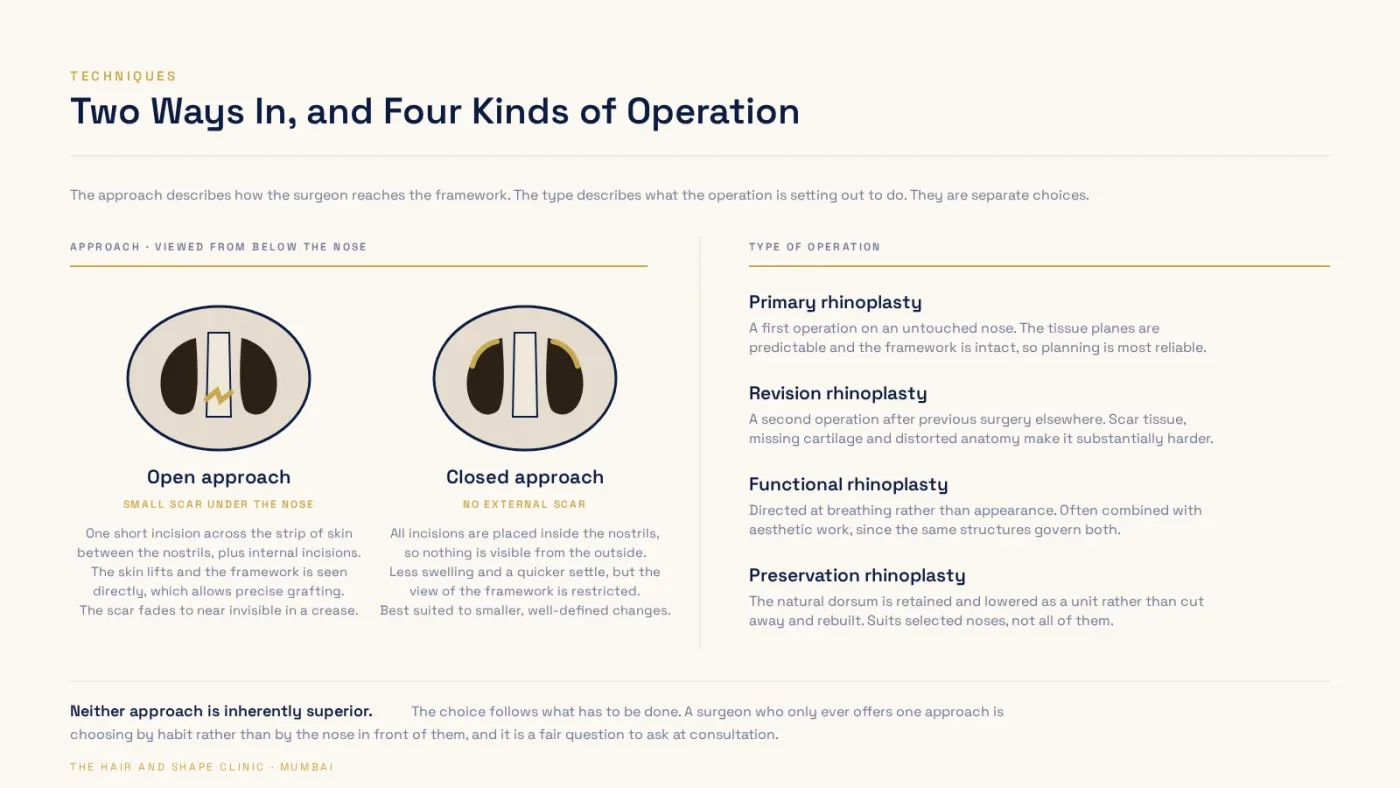
Modern rhinoplasty encompasses several different surgical procedures depending on the patient's concerns.
Cosmetic Rhinoplasty
Performed to improve the external appearance of the nose while maintaining normal breathing function.
Functional Rhinoplasty
Addresses structural abnormalities that interfere with nasal airflow.
The primary objective is to improve breathing while preserving facial aesthetics.
Septorhinoplasty
Combines rhinoplasty with correction of a deviated nasal septum.
This approach improves both nasal appearance and breathing function simultaneously.
Ethnic Rhinoplasty
Preserves important ethnic facial characteristics while refining selected aspects of nasal shape.
The objective is enhancement rather than altering ethnic identity.
Revision Rhinoplasty
Performed to correct cosmetic concerns or functional problems following previous nasal surgery.
Revision procedures are often more technically complex because of scar tissue and altered anatomy.
Reconstructive Rhinoplasty
Restores nasal form and function following trauma, congenital abnormalities, tumour removal, or severe structural damage.
What Results Can You Expect After Rhinoplasty?
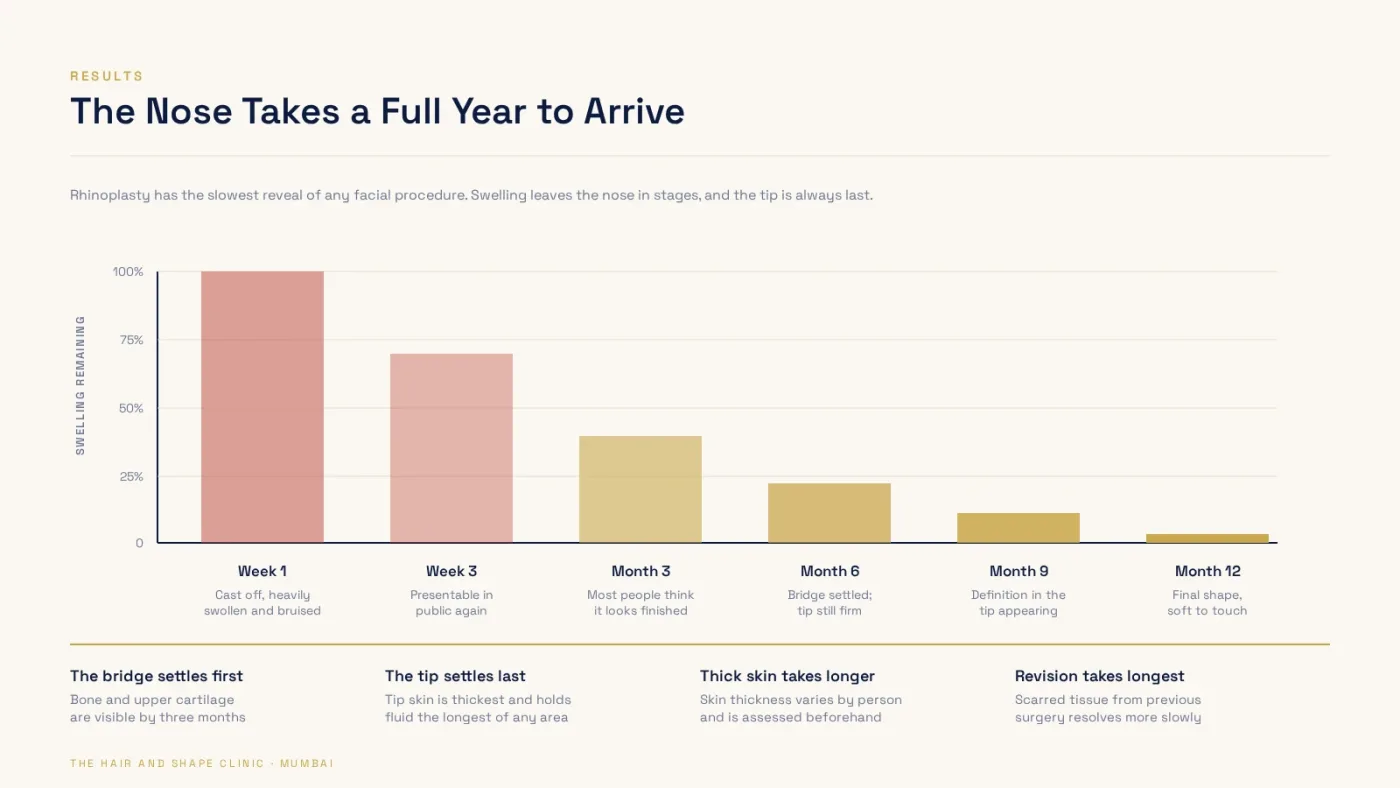
Rhinoplasty produces long-lasting structural changes, but visible improvements develop gradually as swelling resolves.
Immediately after surgery, the nose appears swollen and often larger than the final outcome.
Over time, the tissues settle into their new position.
Patients typically notice:
Improved Facial Harmony
The nose appears more balanced with surrounding facial features.
Better Nasal Shape
The bridge, tip, nostrils, and profile reflect the personalized surgical plan.
Improved Breathing
Patients undergoing functional correction often experience easier airflow after healing.
Natural Appearance
Modern rhinoplasty aims to produce results that appear refined rather than obviously operated upon.
Long-Term Stability
Once healing is complete, the structural changes are generally permanent, although the nose continues to age naturally along with the rest of the face.
Final refinement, particularly around the nasal tip, may continue for several months after surgery.
What Is Recovery Like After Rhinoplasty?
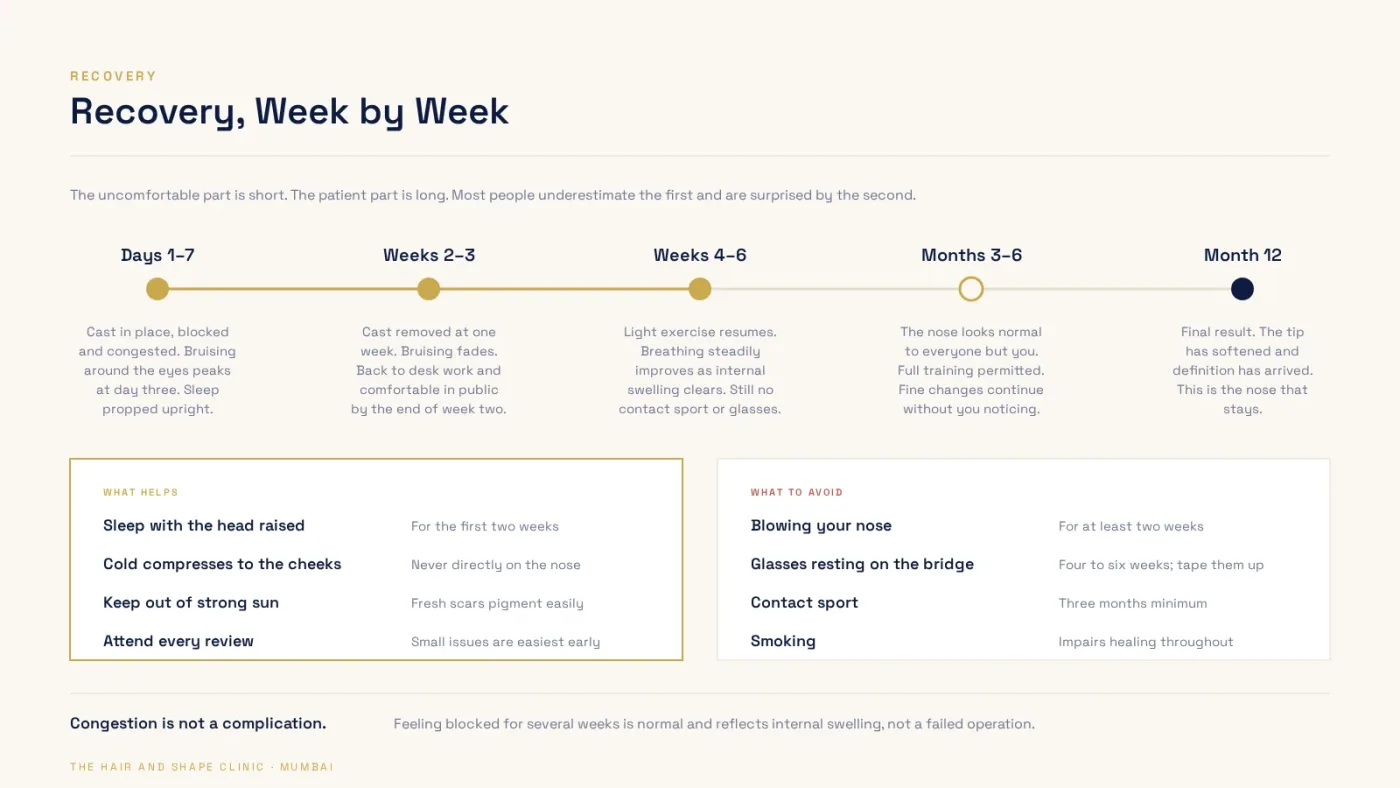
Healing occurs gradually over several months, although most patients resume many routine activities much sooner.
Recovery generally progresses through several stages.
Immediately After Surgery
You may experience:
Swelling.
Mild bruising around the eyes.
Nasal congestion.
Minor discomfort.
Temporary splint on the nose.
These symptoms are expected and improve progressively.
First Week
The external splint and, if used, sutures are usually removed during the first postoperative visit.
Bruising often begins fading during this period.
Two to Four Weeks
Most visible bruising resolves.
Swelling gradually decreases.
Many patients feel comfortable returning to work, social activities, and daily routines.
Several Months
The nose continues refining as deeper swelling slowly subsides.
Tip definition becomes progressively more apparent.
One Year
Most patients appreciate the final result approximately 12 months after surgery, although subtle refinement may continue beyond this in some individuals.
Are There Any Risks or Limitations?
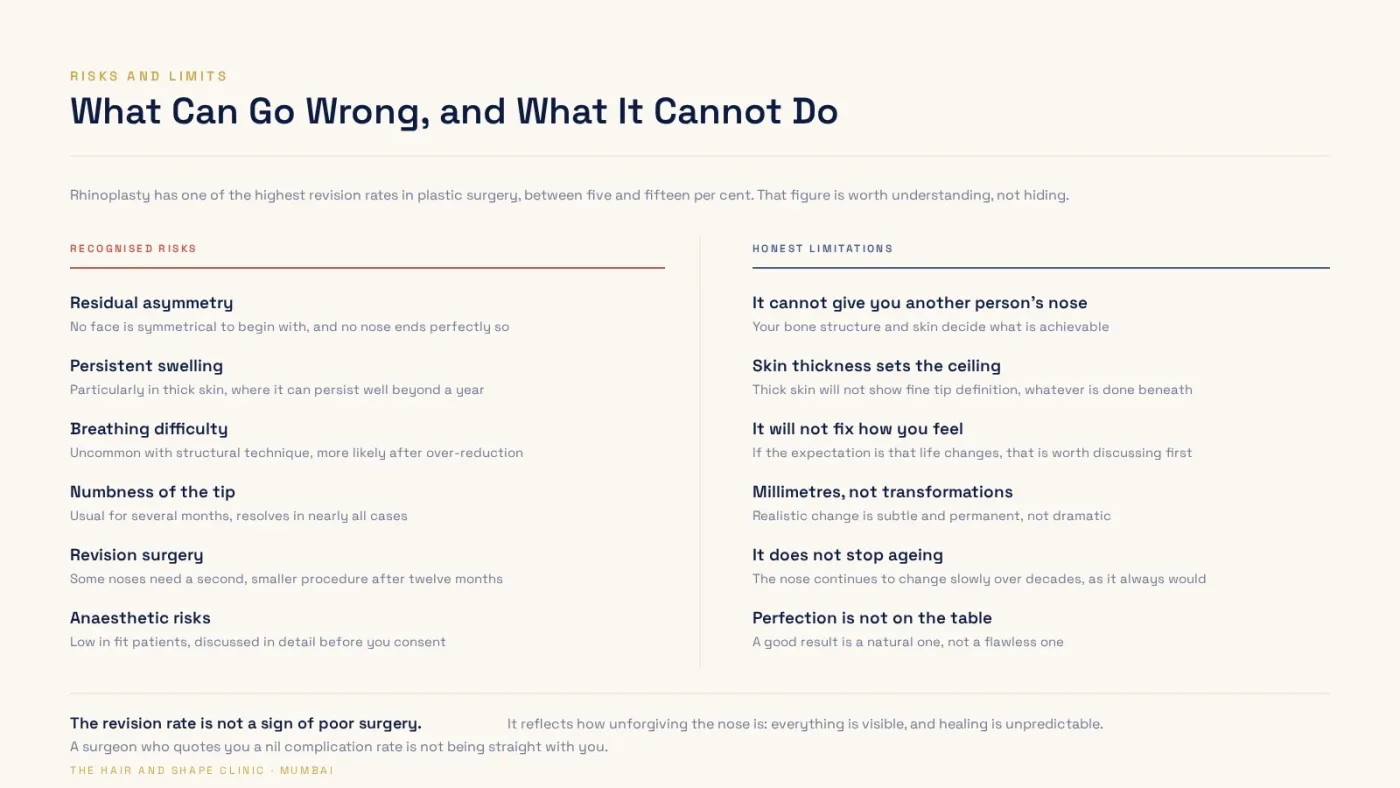
Rhinoplasty is generally considered safe when performed by an experienced plastic surgeon, but like every surgical procedure, it carries potential risks.
Possible complications include:
Bleeding.
Infection.
Temporary numbness.
Swelling.
Bruising.
Delayed wound healing.
Minor asymmetry.
Scar formation.
Persistent breathing difficulty.
Need for revision surgery.
It is equally important to understand that perfect facial symmetry is neither natural nor surgically achievable.
The objective is meaningful improvement while preserving normal nasal structure and function.
Careful surgical planning and realistic expectations contribute significantly to patient satisfaction.
How Much Does Rhinoplasty Cost in Mumbai?
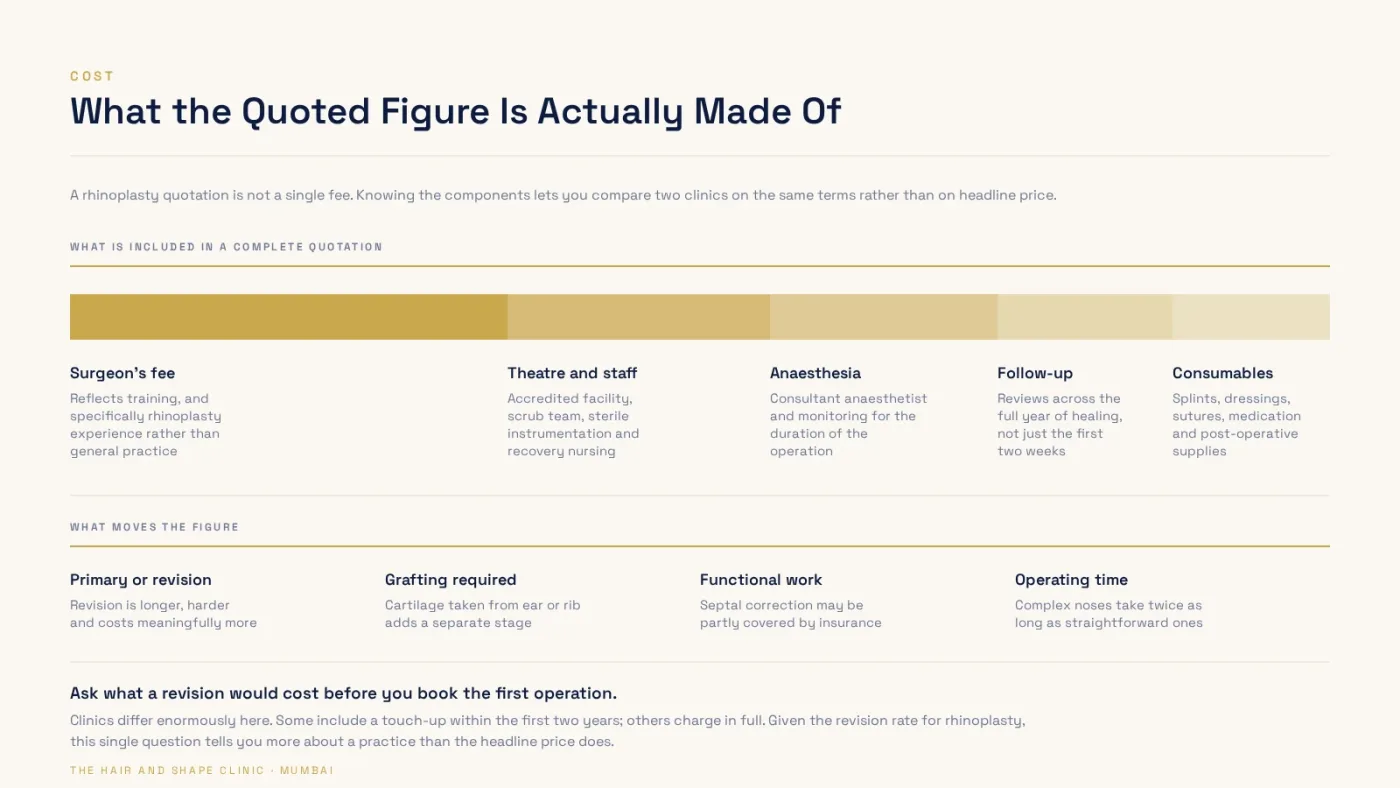
The cost of rhinoplasty varies according to each patient's anatomy and surgical requirements.
Factors influencing the overall cost include:
Complexity of the procedure.
Cosmetic versus functional correction.
Primary or revision surgery.
Requirement for cartilage grafting.
Operating facility charges.
Anaesthesia.
Postoperative care.
Following a detailed consultation, you will receive a personalized treatment plan explaining the recommended procedure, expected outcomes, recovery timeline, and associated costs.
Why Choose Hair & Shape for Rhinoplasty?
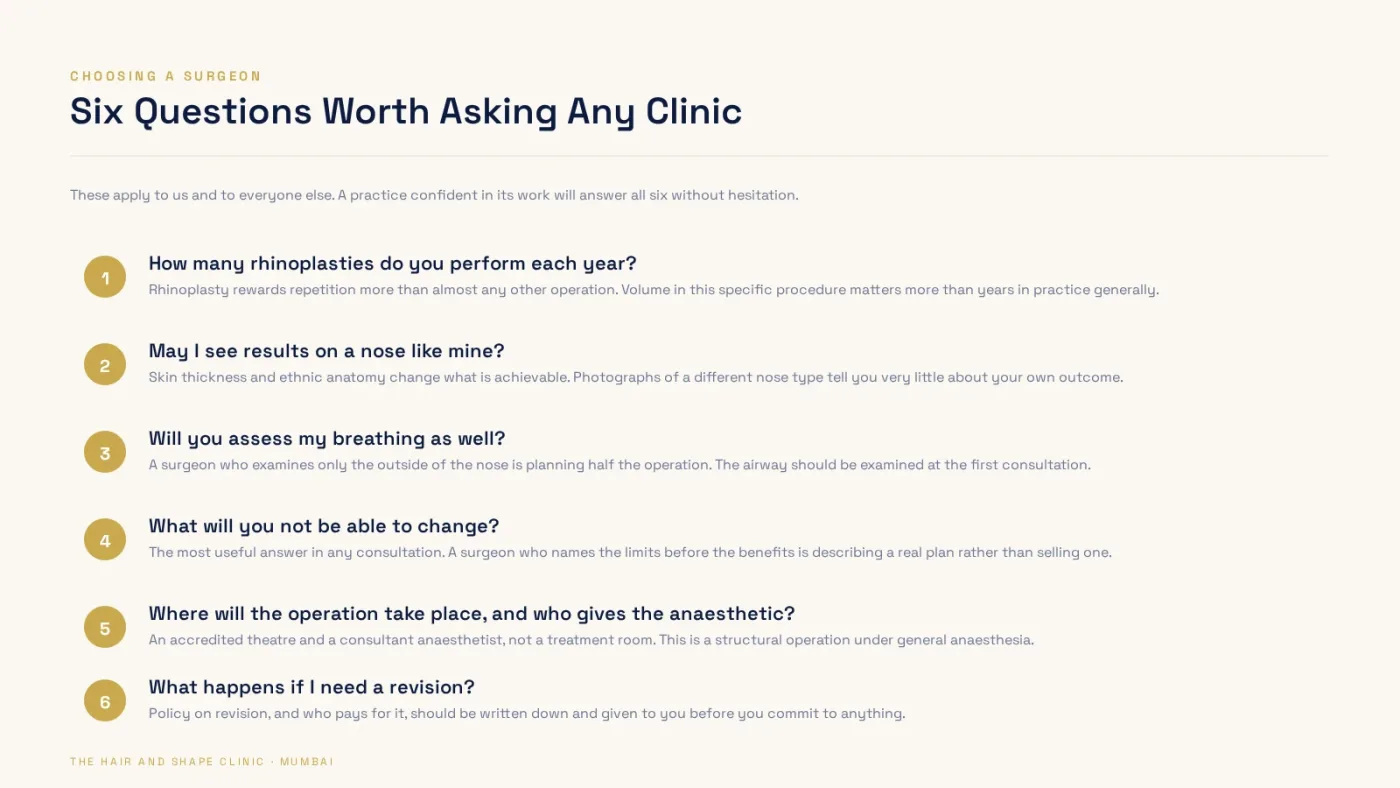
Successful rhinoplasty requires technical precision, artistic judgment, and a thorough understanding of both nasal anatomy and facial aesthetics. Every decision, from reshaping cartilage to preserving breathing function, must be carefully balanced to achieve natural, long-lasting results.
At Hair & Shape Clinic, rhinoplasty planning begins with a comprehensive assessment of your facial proportions, nasal structure, skin quality, cartilage support, and functional concerns. Rather than applying standardized measurements or trends, the surgical approach is individualized to complement your unique facial features while maintaining structural stability and normal nasal function.
The emphasis is on creating balanced, harmonious results that enhance your appearance without making the nose look artificial or overcorrected.
Why Does Personalized Rhinoplasty Planning Matter?
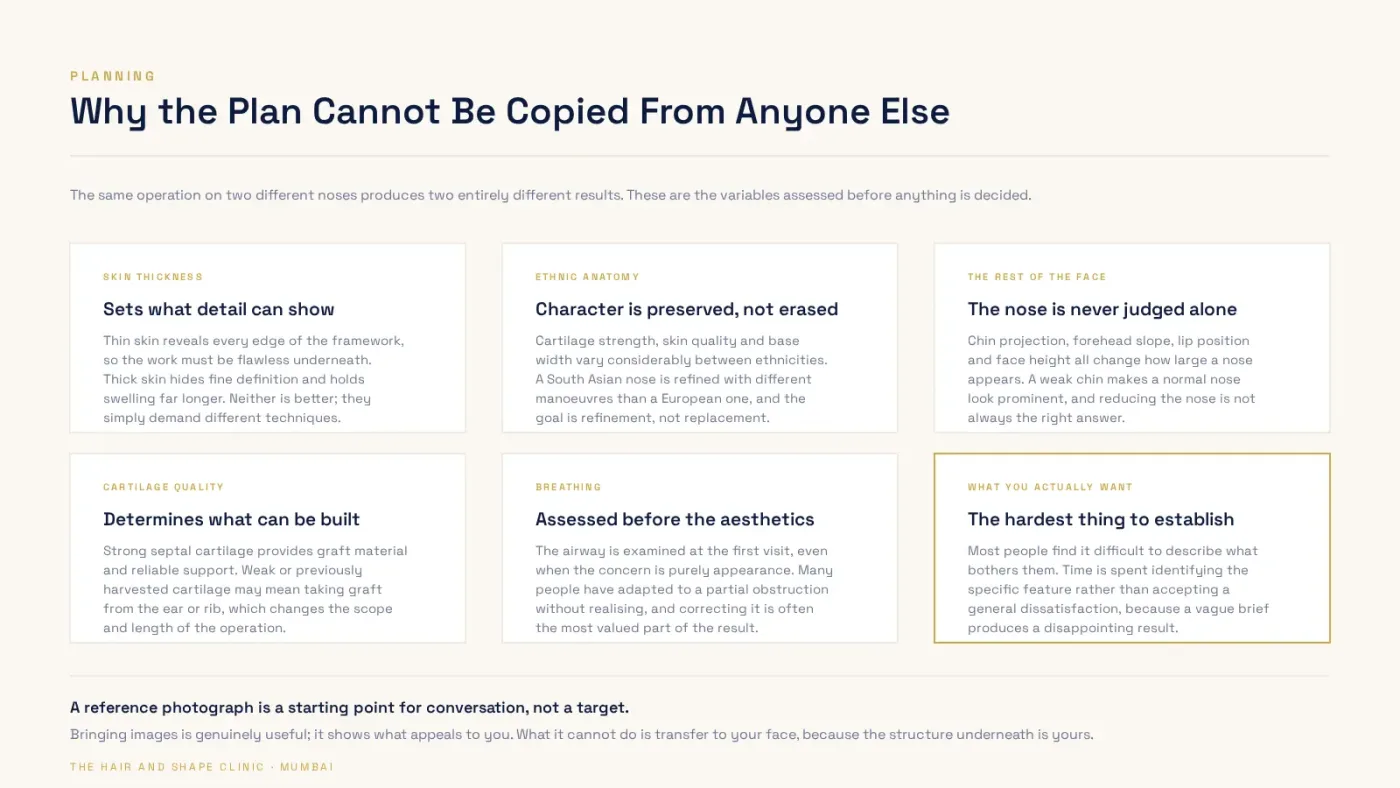
The nose is one of the most complex structures of the face, and even small changes can significantly influence overall appearance and breathing.
Every Face Is Different
Facial proportions, skin thickness, cartilage strength, and nasal anatomy vary considerably between individuals.
Function Is as Important as Appearance
A well-performed rhinoplasty should improve or preserve breathing while enhancing facial harmony.
Surgical Techniques Must Be Individualized
The appropriate approach depends on the patient's anatomy, goals, and whether cosmetic, functional, or reconstructive correction is required.
Healing Takes Time
Because swelling resolves gradually, patience is essential before evaluating the final outcome.
Natural Results Last Longer
Conservative, structurally balanced surgery is more likely to produce stable results that continue to look natural over time.
International Patients Seeking Rhinoplasty in Mumbai
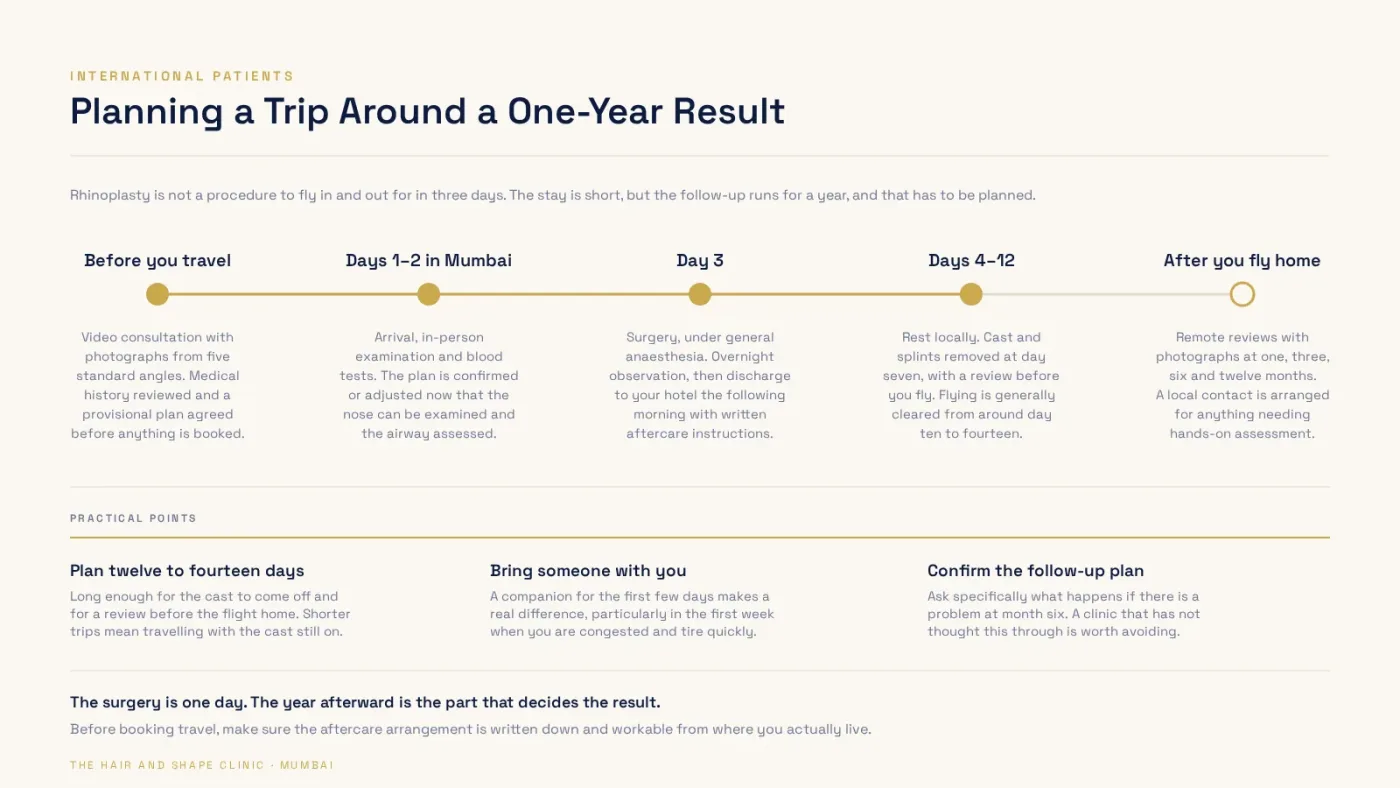
Hair & Shape Clinic welcomes patients from across India and around the world seeking advanced cosmetic and functional nasal surgery.
Our international patient pathway is designed to simplify consultation, travel planning, surgery, and postoperative care.
Before You Travel
Virtual consultations, medical history review, facial photographs, and discussion of your goals help determine the most appropriate surgical plan before your visit.
During Your Stay
Your treatment includes consultation, surgical planning, rhinoplasty, postoperative monitoring, and detailed recovery instructions before you return home.
Returning Home
Follow-up consultations can often be coordinated remotely. Ongoing guidance regarding healing, activity restrictions, scar care, and long-term recovery helps support optimal results wherever you live.
What to Expect
Consultation
A detailed assessment of your goals, suitability, and a personalised plan.
Preparation
Clear pre-treatment guidance so you arrive fully prepared and at ease.
The Procedure
Your treatment, performed by our specialists with comfort and safety first.
Aftercare
Structured recovery support and follow-ups to protect your results.
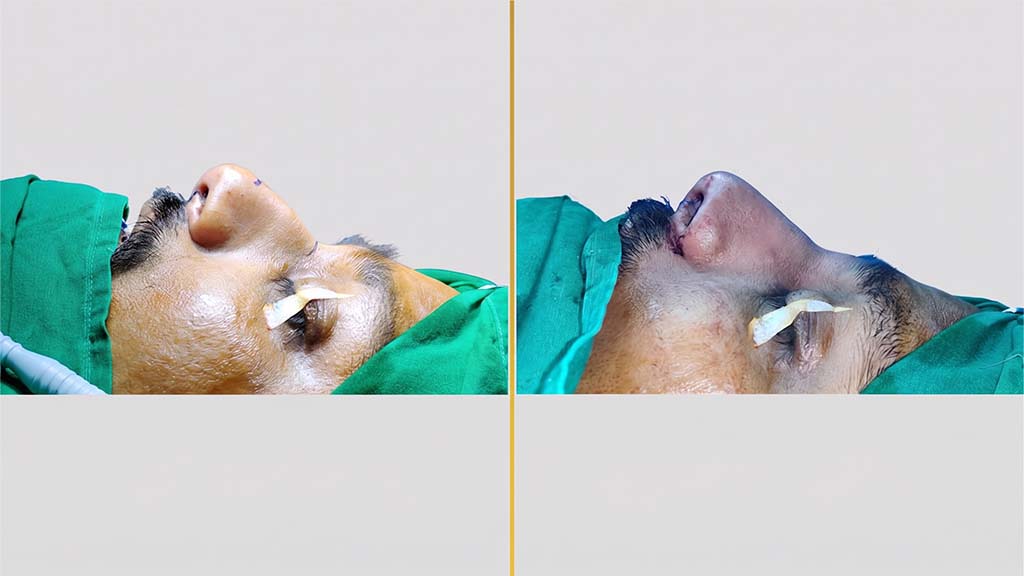
Before & After Transformations
Frequently Asked Questions
Everything you need to know about Rhinoplasty (Nose Surgery). Still curious? Our team is one message away.
How do surgeons decide how much to change the nose?
The objective isn't to remove as much as possible. Every adjustment is based on facial proportions, structural stability, skin thickness, and long-term harmony, ensuring the nose complements the rest of the face rather than becoming its focal point.
Can rhinoplasty change the way my voice sounds?
No. Rhinoplasty reshapes the external nose and internal nasal structures when necessary, but it does not alter the vocal cords or the natural character of your voice.
Is revision rhinoplasty more complex than primary rhinoplasty?
Yes. Previous surgery can alter cartilage support, anatomy, and scar tissue, making revision procedures significantly more complex and requiring highly individualized planning.
Why does swelling after rhinoplasty last so long?
The nose contains delicate soft tissues that heal gradually. While the initial swelling improves within weeks, subtle refinement continues over several months as the tissues settle into their final shape.
What is the difference between rhinoplasty and septorhinoplasty?
Rhinoplasty focuses primarily on reshaping the nose. Septorhinoplasty combines cosmetic refinement with correction of the nasal septum to address breathing concerns and structural support
Will my nose still look like mine after surgery?
It should. The goal is refinement, not replacement. Successful rhinoplasty preserves your facial identity while improving proportion and balance.
Can rhinoplasty improve breathing as well as appearance?
Yes. If structural issues such as a deviated septum or narrowed nasal passages affect airflow, rhinoplasty can often be combined with functional correction to improve breathing while refining appearance.
How do I know if my nose is actually out of proportion?
A nose isn't evaluated in isolation. Its relationship with the forehead, lips, chin, and overall profile determines facial harmony. Surgical planning begins with the face—not the nose alone.
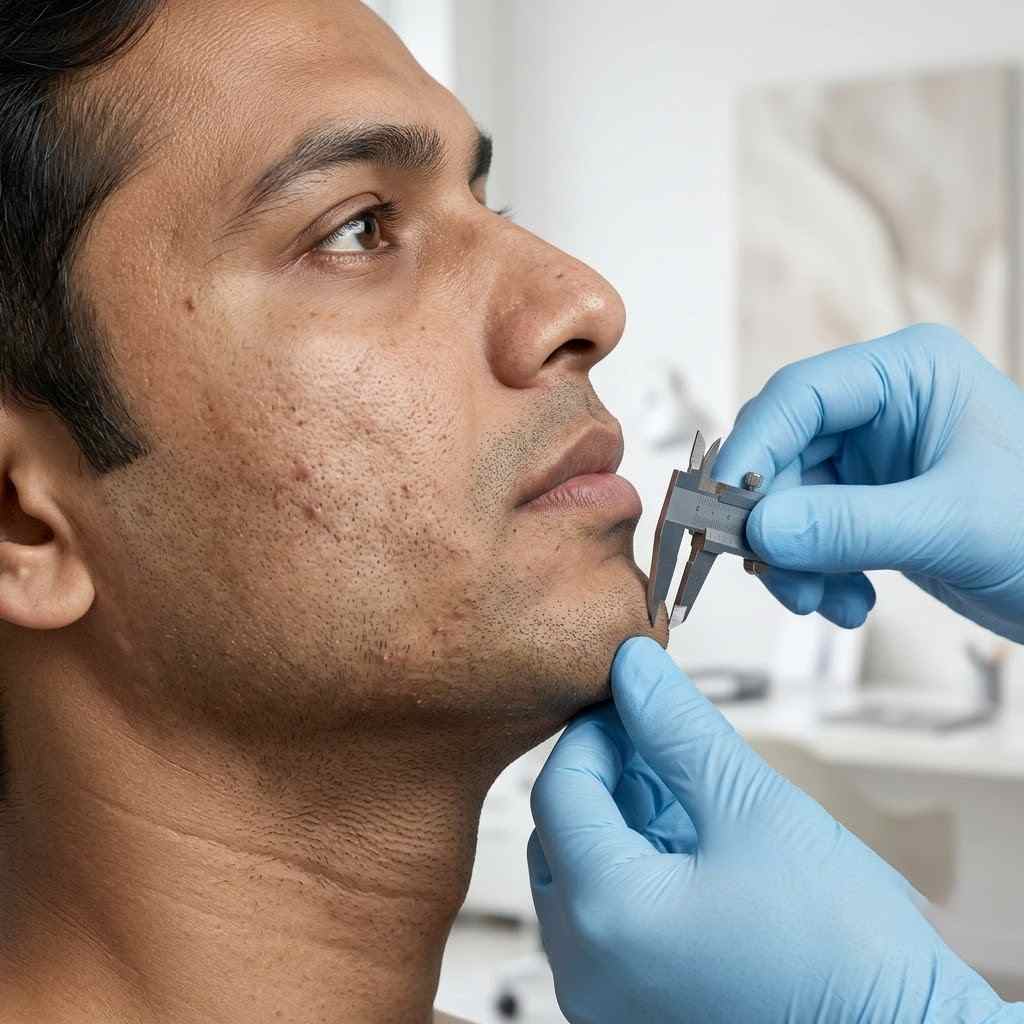

Begin Your Rhinoplasty (Nose Surgery) Journey
Book a consultation today and let our specialists craft a plan built entirely around you.