Mustache Hair Transplant In Mumbai
Restore mustache density and shape with meticulous follicle-by-follicle work.
Introduction
The moustache occupies a small area of the face, but its density, borders, symmetry, and direction of growth can significantly influence facial appearance. Some men naturally have sparse or uneven moustache growth, while gaps may also develop because of scars, burns, surgery, injury, or loss of existing follicles.
A mustache hair transplant restores hair to the upper-lip region by transferring suitable follicles, usually from a stable scalp donor area. At Hair & Shape Clinic in Mumbai, the procedure is planned around the patient’s upper-lip anatomy, existing moustache pattern, facial proportions, and preferred style rather than creating a standard shape for everyone.
Individual follicular units are generally harvested using FUE and implanted one by one. Since moustache hairs emerge at very acute angles and change direction across the upper lip, careful recipient-site creation is especially important for a natural appearance.
While planning the procedure, Dr. Umang Kothari considers donor-hair characteristics along with the required width, density, spacing, and symmetry of the moustache. Once the transplanted follicles establish growth, the new hair can be trimmed, shaved, and styled similarly to naturally occurring moustache hair.
What Is a Mustache Hair Transplant?
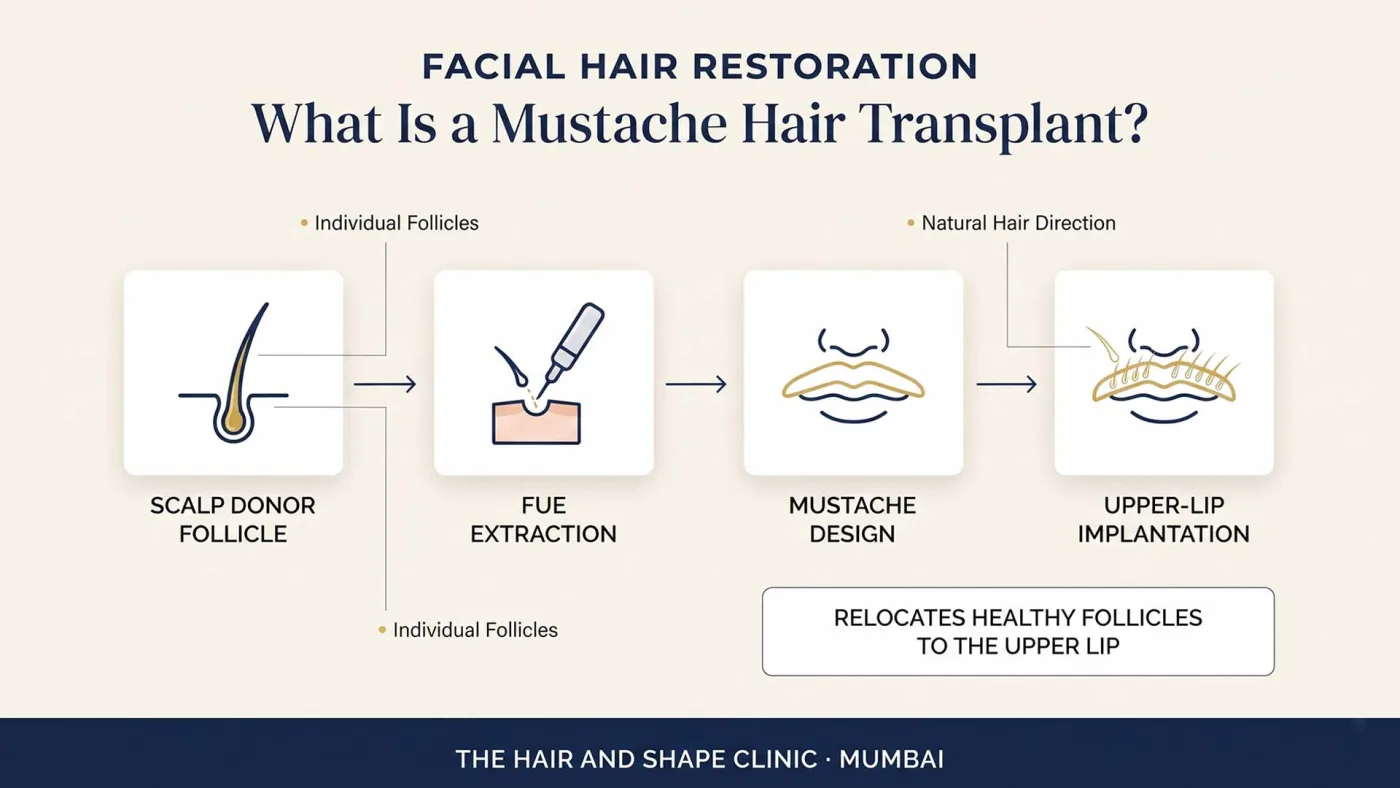
A Mustache Hair Transplant is a cosmetic hair restoration procedure that restores or enhances hair growth in the upper lip by transplanting healthy follicular units from the permanent donor region of the scalp.
The procedure is most commonly performed using Follicular Unit Extraction (FUE), where individual follicular units are carefully harvested one by one using precision micro-punch instruments. These follicles are then implanted into carefully planned recipient sites within the moustache.
Each transplanted follicle retains the biological characteristics of the donor scalp and continues producing permanent hair after successful healing.
The objective extends beyond simply increasing hair density.
Every follicle must be positioned according to:
Natural moustache direction.
Hair angle.
Hair spacing.
Hairline symmetry.
Upper lip contours.
Facial proportions.
When performed correctly, the transplanted hair integrates naturally with existing moustache hair and can be groomed without distinguishing it from naturally growing facial hair.
Why Do Some Men Have Sparse Mustache Growth?
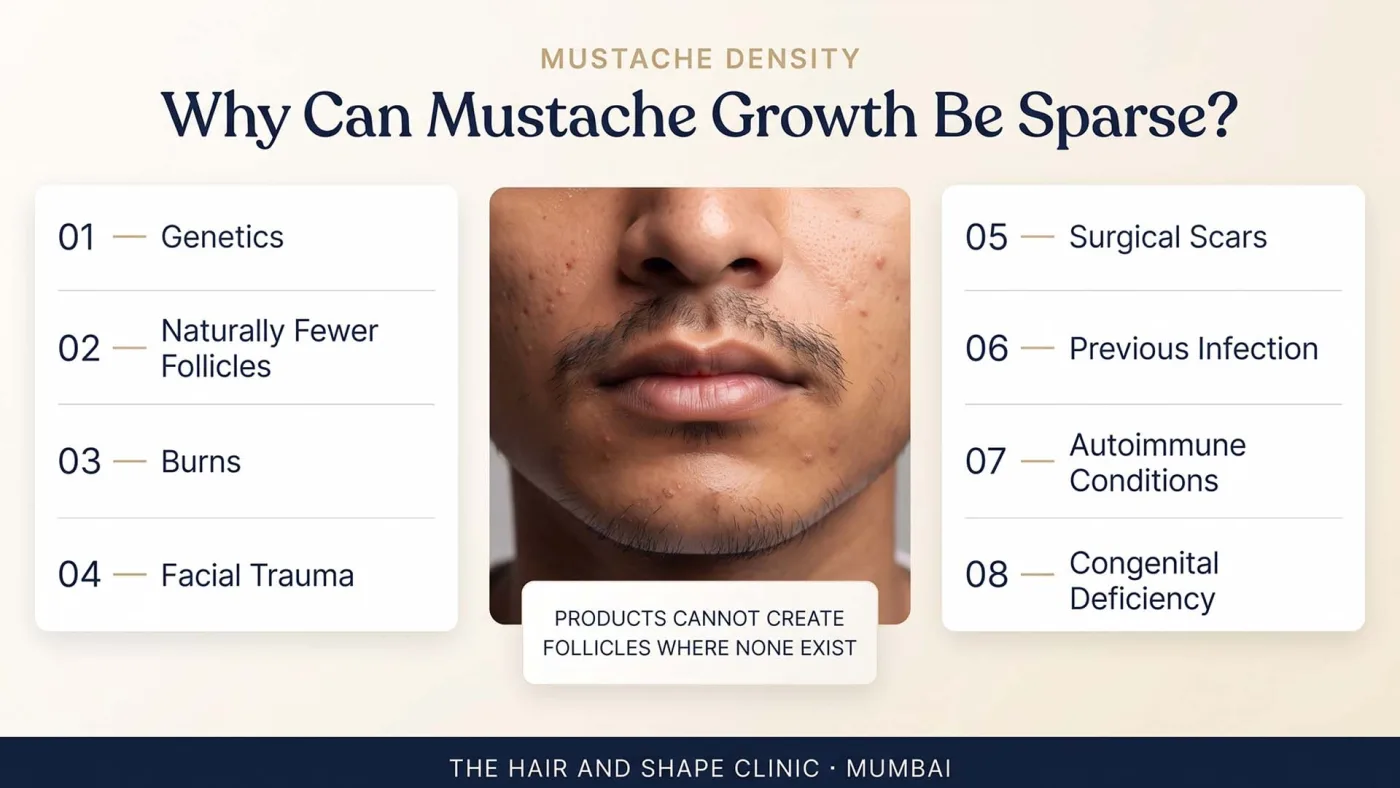
Moustache growth is determined primarily by genetics and hormonal influences.
During puberty, testosterone is converted into dihydrotestosterone (DHT) within facial hair follicles.
Unlike scalp follicles, where DHT contributes to hair thinning in genetically susceptible individuals, facial follicles generally respond by producing:
Thicker hair shafts.
Longer terminal hairs.
Increased facial hair density.
Progressive maturation of moustache growth.
However, hormonal stimulation can only enlarge existing follicles.
If certain portions of the upper lip naturally contain very few follicles, hormones cannot create entirely new hair-producing structures.
Other causes of moustache hair loss include:
Burns.
Facial trauma.
Surgical scars.
Previous infections.
Congenital absence of moustache hair.
Certain autoimmune disorders.
Accidental follicular damage.
Once follicles are permanently destroyed, they cannot regenerate naturally, making transplantation one of the most effective options for restoring permanent moustache growth.
How Does a Mustache Hair Transplant Work?
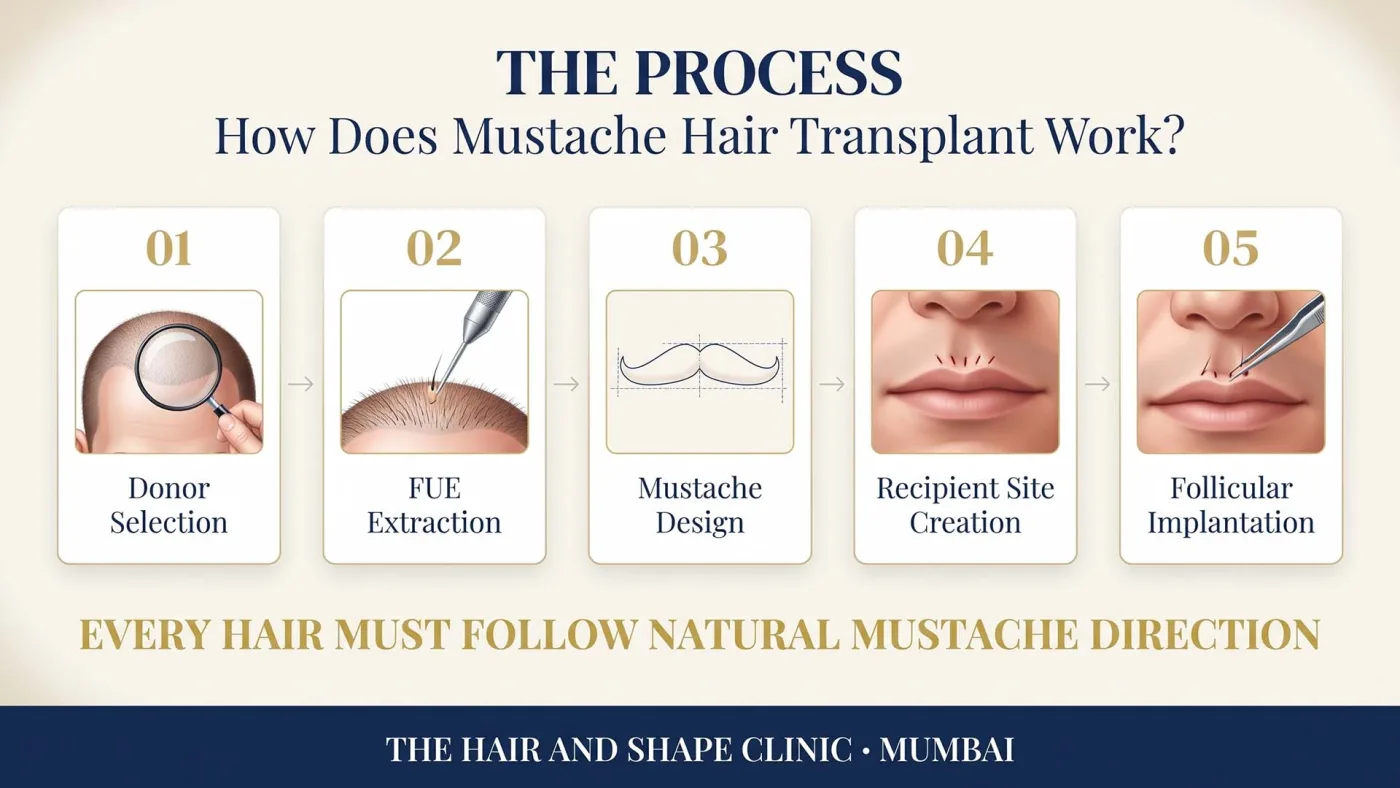
A Mustache Hair Transplant involves relocating healthy scalp follicles into areas of the upper lip where greater moustache density or improved shape is desired.
Although the surgical principles resemble scalp and beard transplantation, the procedure demands exceptional precision because the moustache occupies a relatively small area where every individual hair contributes to the final appearance.
The treatment generally involves several stages.
Donor Follicle Selection
Healthy follicular units are selected from the permanent donor region.
Whenever possible, follicles with characteristics that closely resemble natural moustache hair are chosen to create the most harmonious appearance.
Individual Follicle Extraction
Each follicular unit is harvested individually using precision micro-punch instruments while minimizing trauma to the donor scalp.
Mustache Design
The moustache is carefully designed according to:
Facial proportions.
Upper lip anatomy.
Existing moustache density.
Natural facial symmetry.
Ethnicity.
Desired moustache style.
The design aims to complement the patient's facial features rather than create an artificial or overly dense appearance.
Recipient Site Creation
Tiny recipient sites are created according to the natural growth pattern of moustache hair.
Hair emerging from the upper lip grows at particularly acute angles, making accurate recipient site creation one of the most technically demanding stages of the procedure.
Follicular Implantation
Each follicular unit is individually implanted while carefully maintaining the correct direction, spacing, and orientation required for natural moustache growth.
Why Is Mustache Hair Transplant More Technically Demanding?

Although the treatment area is relatively small, the moustache is one of the most visually noticeable parts of the face.
Small errors that might go unnoticed on the scalp can become obvious around the upper lip.
Several factors increase the technical complexity of moustache transplantation.
Extremely Acute Hair Angles
Moustache hairs emerge almost parallel to the skin surface, requiring exceptionally precise implantation.
High Facial Visibility
Because the moustache occupies the centre of the face, symmetry is immediately noticeable.
Unique Growth Directions
Hair above the upper lip naturally changes direction across different regions, especially near the philtrum and corners of the mouth.
Fine Border Definition
The upper edge of the moustache requires careful placement to avoid creating an unnaturally sharp or artificial appearance.
Natural Density Variation
A realistic moustache contains subtle differences in density rather than uniform thickness throughout.
Who Is a Good Candidate for Mustache Hair Transplant?
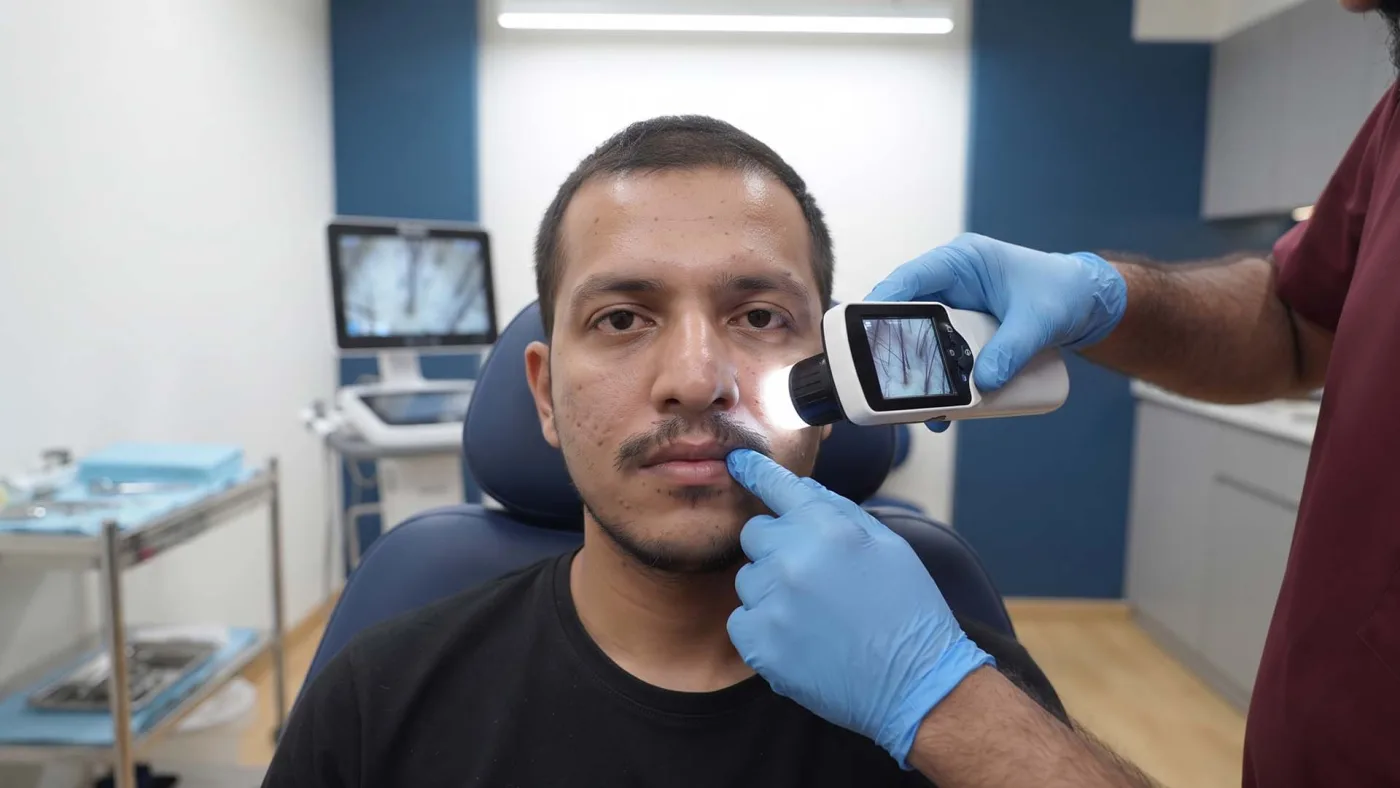
A Mustache Hair Transplant may be suitable for individuals seeking permanent improvement in moustache density, shape, or symmetry.
You may be a suitable candidate if you:
Have naturally sparse moustache growth.
Wish to improve moustache definition.
Have patchy hair growth above the upper lip.
Have moustache scars following trauma or surgery.
Possess healthy donor hair on the scalp.
Are in good overall health.
Have realistic expectations regarding treatment outcomes.
Final suitability depends on donor quality, facial anatomy, existing moustache characteristics, medical history, and individual cosmetic goals.
What Conditions Can a Mustache Hair Transplant Treat?
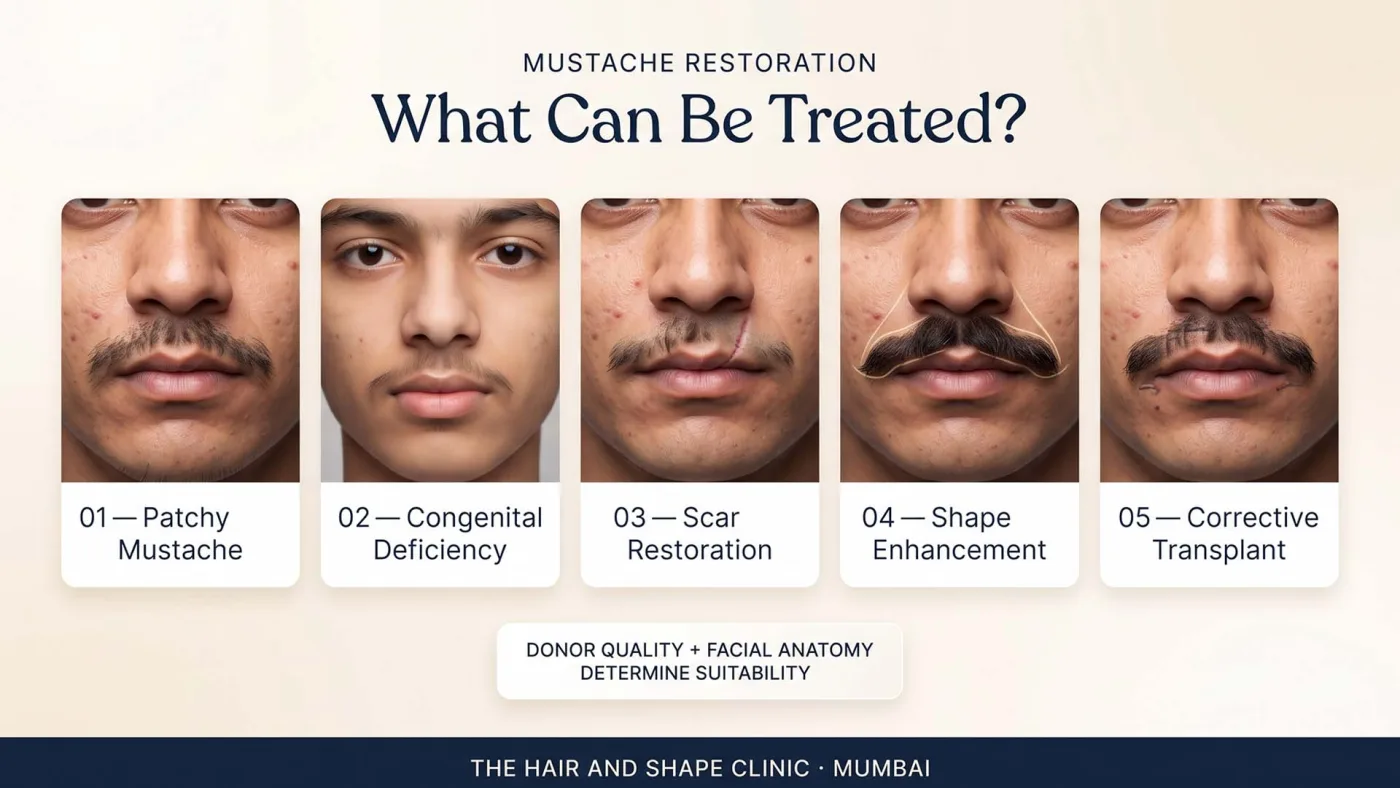
Mustache transplantation can improve several cosmetic and reconstructive concerns involving upper lip hair.
Patchy Mustache Growth
Fills uneven or sparse areas to create greater continuity and fullness.
Congenital Mustache Deficiency
Restores moustache hair in individuals who naturally developed minimal facial hair.
Scar Restoration
Improves selected scars affecting the upper lip by transplanting healthy follicles into suitable scar tissue.
Mustache Shape Enhancement
Refines moustache borders, improves symmetry, and enhances overall facial balance according to individual aesthetic preferences.
Corrective Facial Hair Transplant
Improves previous moustache or beard transplantation procedures requiring refinement in density, direction, or symmetry.
Personalized Mustache Hair Transplant
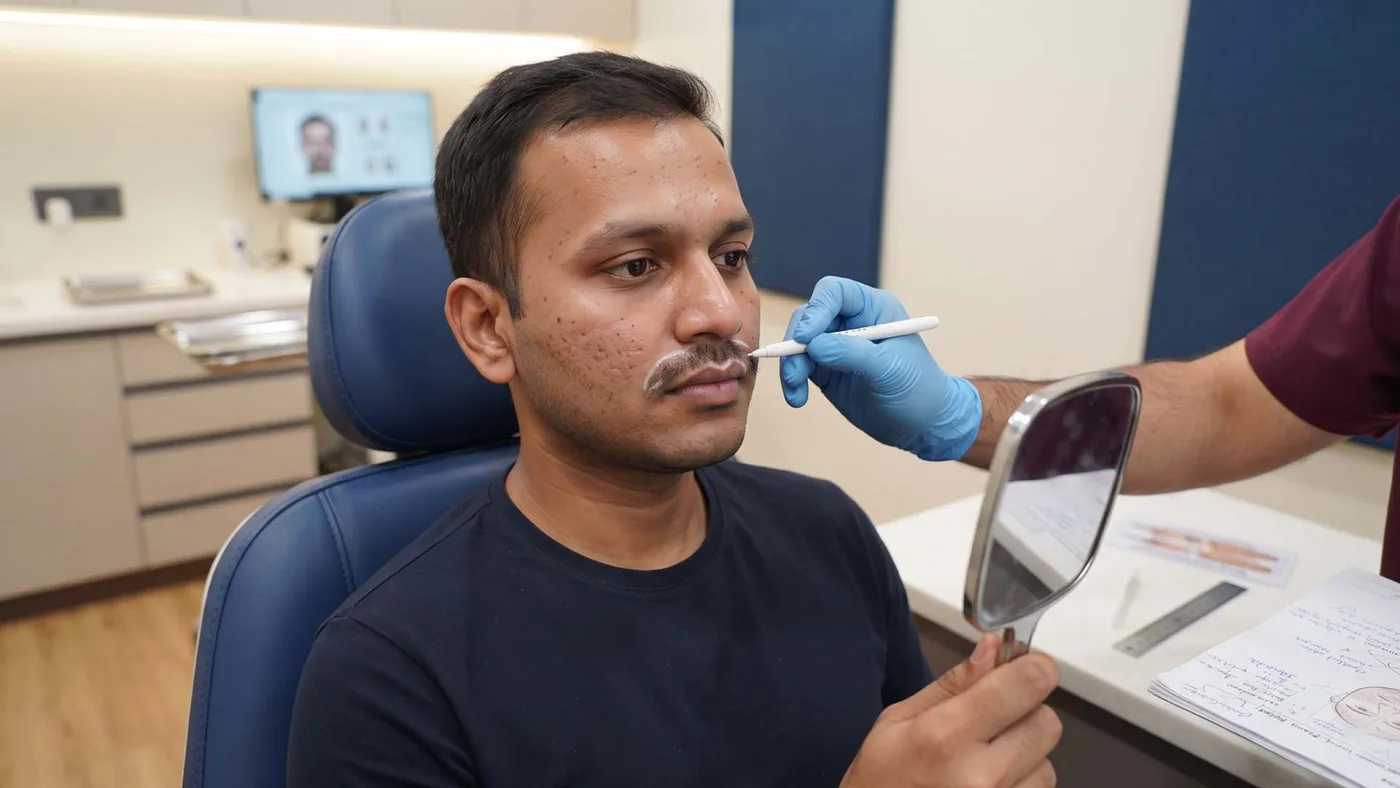
Every moustache should complement the individual's facial features rather than follow a standard template. The ideal density, width, curvature, and border design vary depending on facial proportions, upper lip anatomy, ethnicity, existing facial hair, and personal grooming preferences.
At Hair & Shape Clinic, treatment planning begins with a detailed facial assessment rather than focusing solely on increasing hair density. Donor hair characteristics, natural moustache pattern, upper lip contours, facial symmetry, skin quality, and long-term aesthetic goals are carefully evaluated before designing the transplant.
The objective is to create a moustache that appears completely natural, grows in the correct direction, blends seamlessly with existing facial hair, and enhances the overall balance of the face.
What Happens During a Mustache Hair Transplant Procedure?
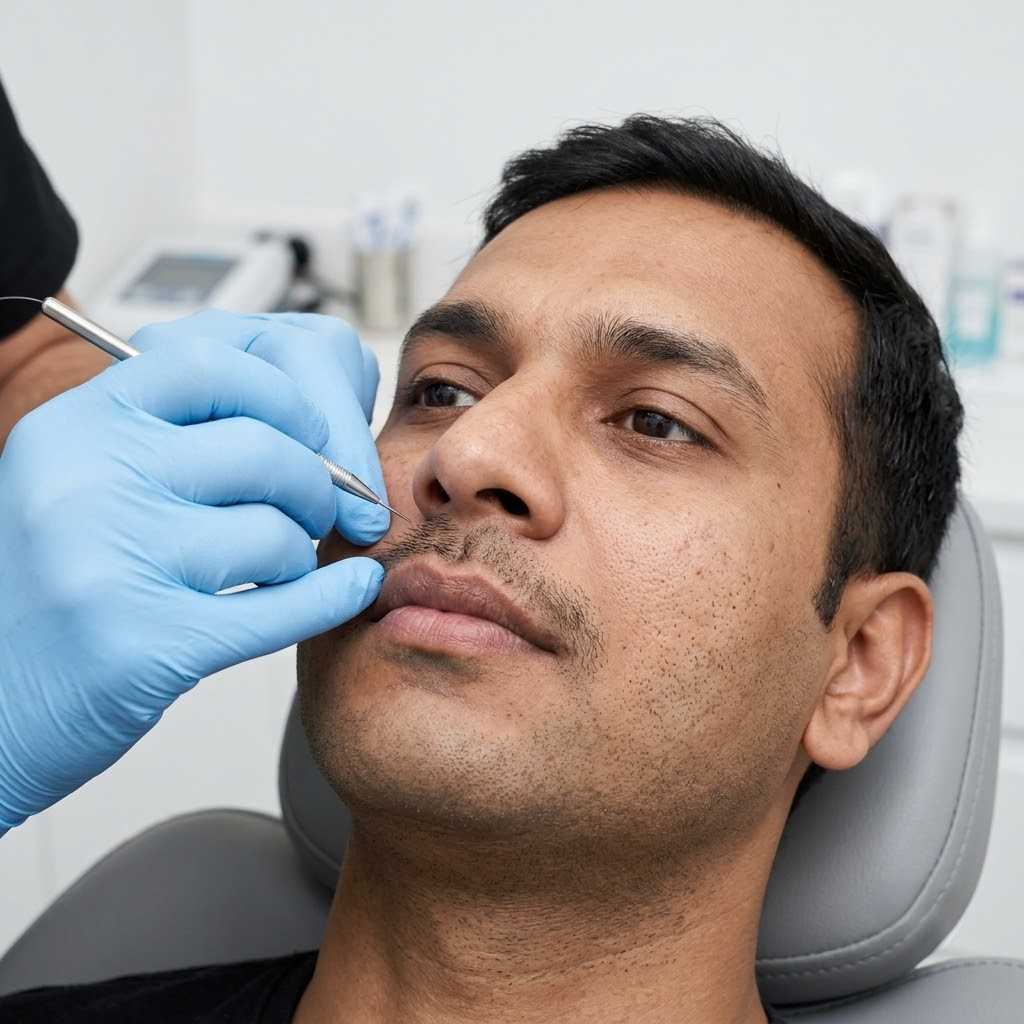
A Mustache Hair Transplant is usually performed under local anaesthesia, allowing you to remain awake and comfortable throughout the procedure. Since only the donor scalp and upper lip are numbed, general anaesthesia is generally unnecessary, and patients can usually return home on the same day.
Although the procedure follows the same Follicular Unit Extraction (FUE) principles used in scalp and beard transplantation, transplanting hair into the moustache requires exceptional precision. The upper lip is one of the most visible areas of the face, and every follicle must be implanted at the correct angle, direction, and density to ensure the final result looks completely natural.
The procedure generally follows these stages.
Step 1: Mustache Design & Facial Analysis
The procedure begins with careful planning rather than immediate follicle extraction.
Your surgeon evaluates:
Facial proportions.
Upper lip anatomy.
Existing moustache density.
Hair texture.
Facial symmetry.
Ethnicity.
Personal grooming preferences.
Desired moustache style.
Rather than creating an unnaturally thick or sharply defined moustache, the goal is to design facial hair that complements your natural facial features and blends harmoniously with any existing beard.
Step 2: Donor Follicle Extraction
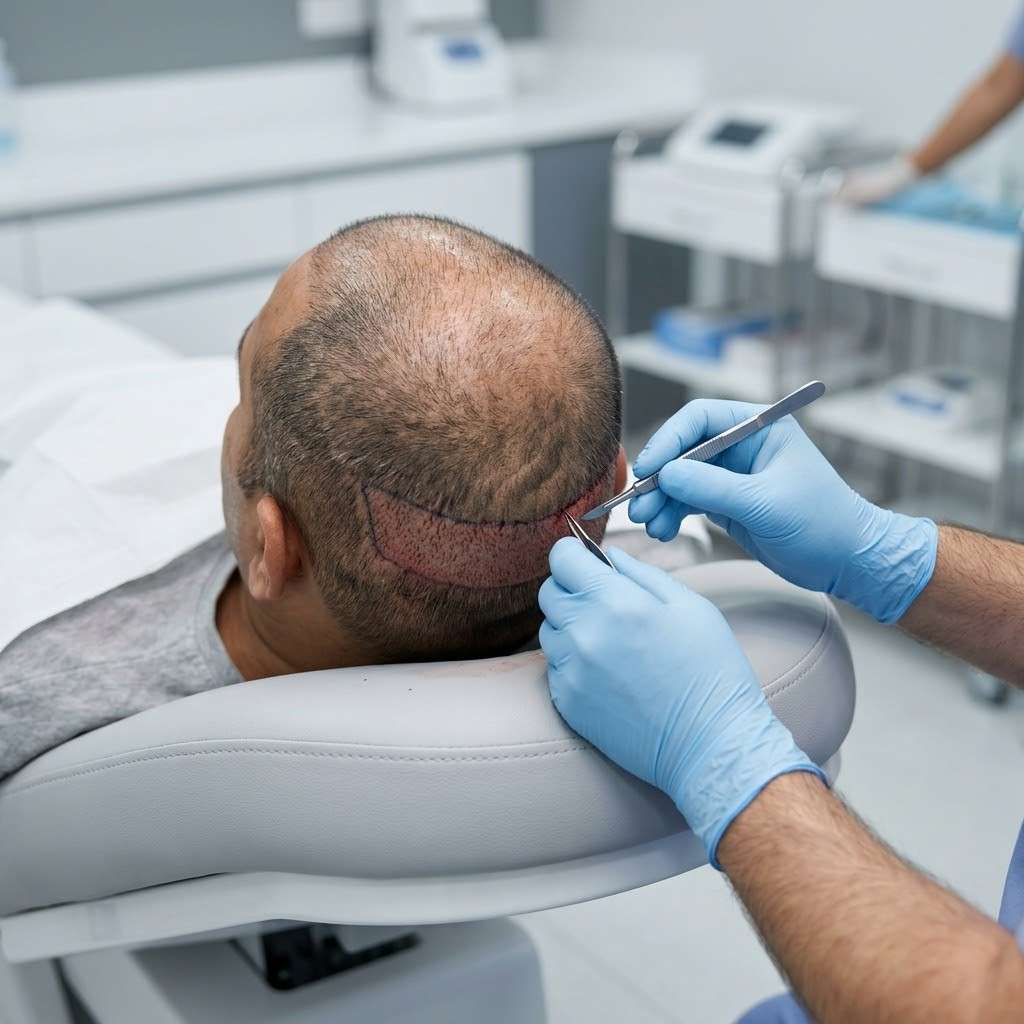
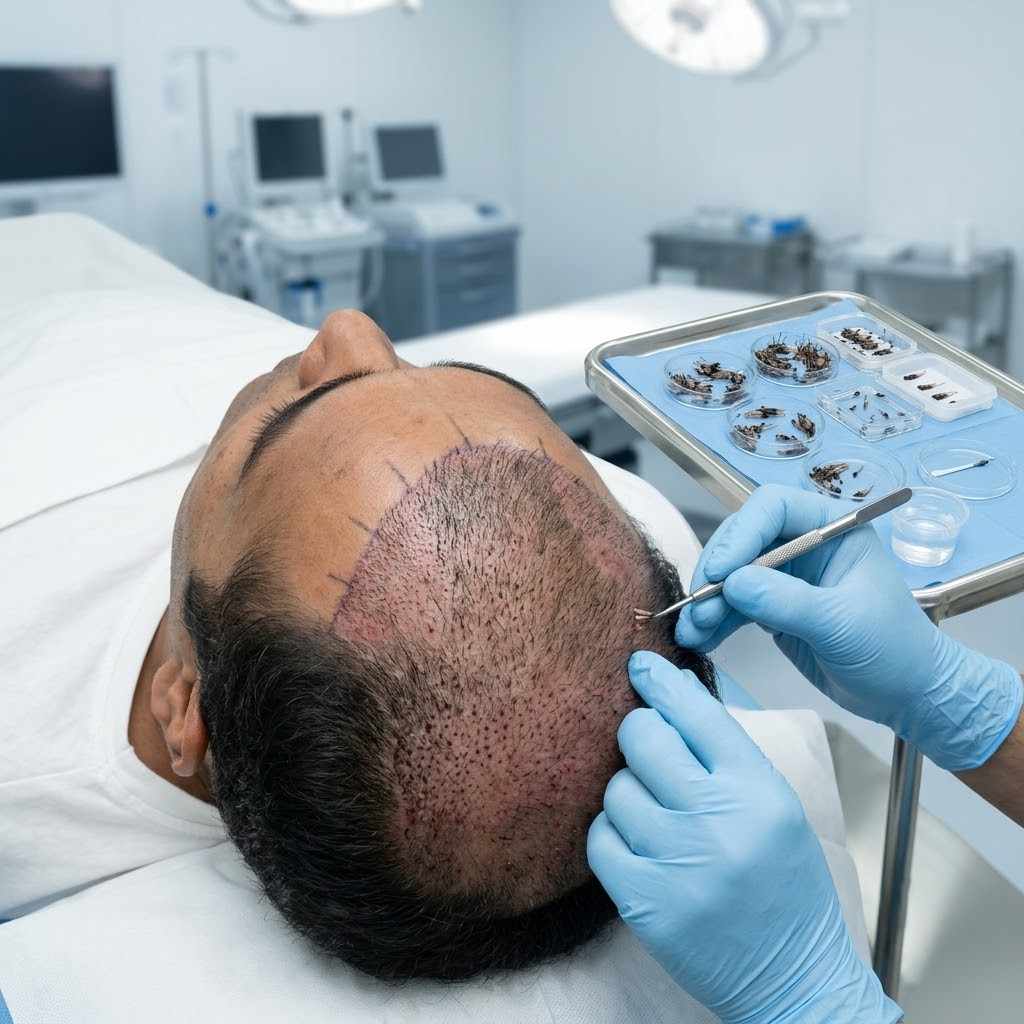
After administering local anaesthesia, healthy follicular units are individually harvested from the permanent donor region using precision micro-punch instruments.
Whenever possible, donor hairs with characteristics that closely resemble natural moustache hair are selected to achieve the most realistic appearance.
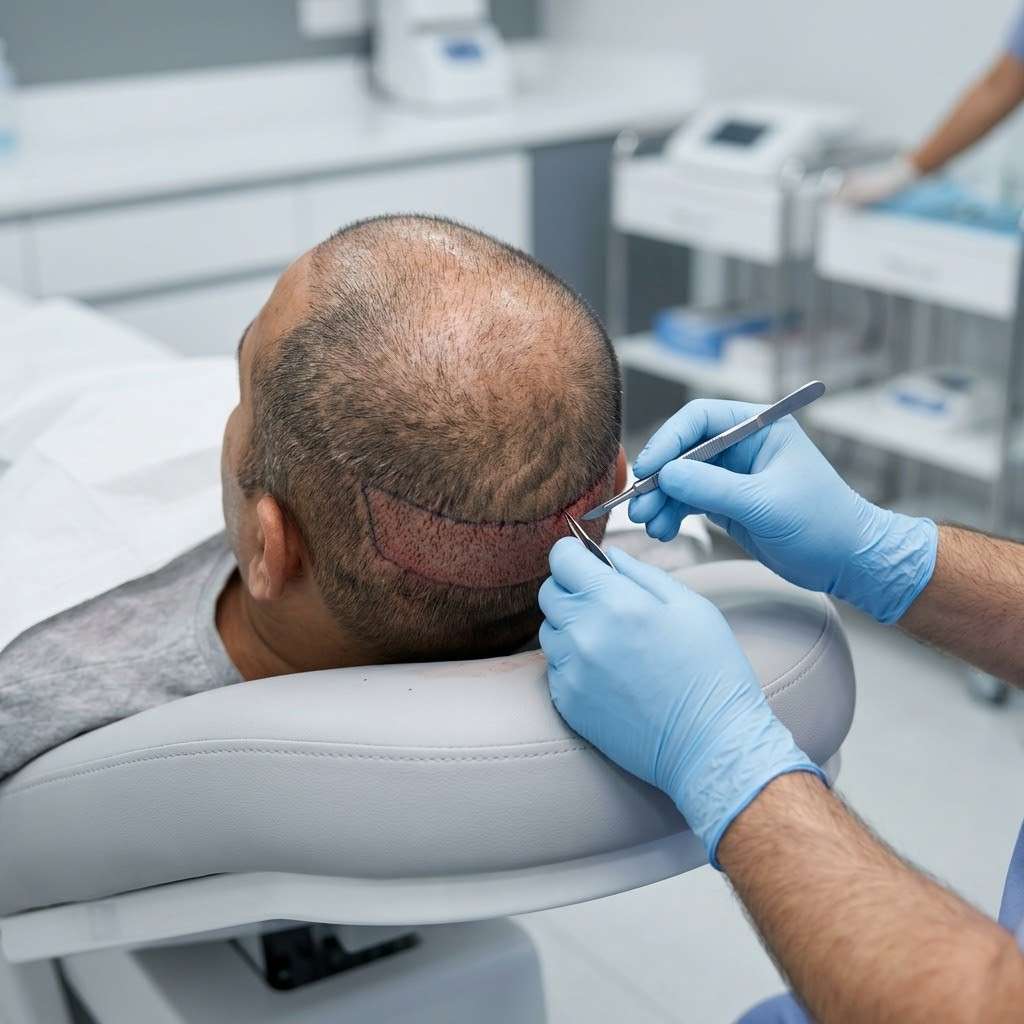
Because follicles are removed individually, the donor area heals without creating a linear scar.
Step 3: Graft Preservation
Immediately after extraction, the follicular grafts are placed in specialized preservation solutions that help maintain:
Cellular hydration.
Stable temperature.
Follicular viability.
Metabolic activity.
Careful handling throughout the procedure minimizes trauma and supports healthy graft survival until implantation.
Step 4: Recipient Site Creation
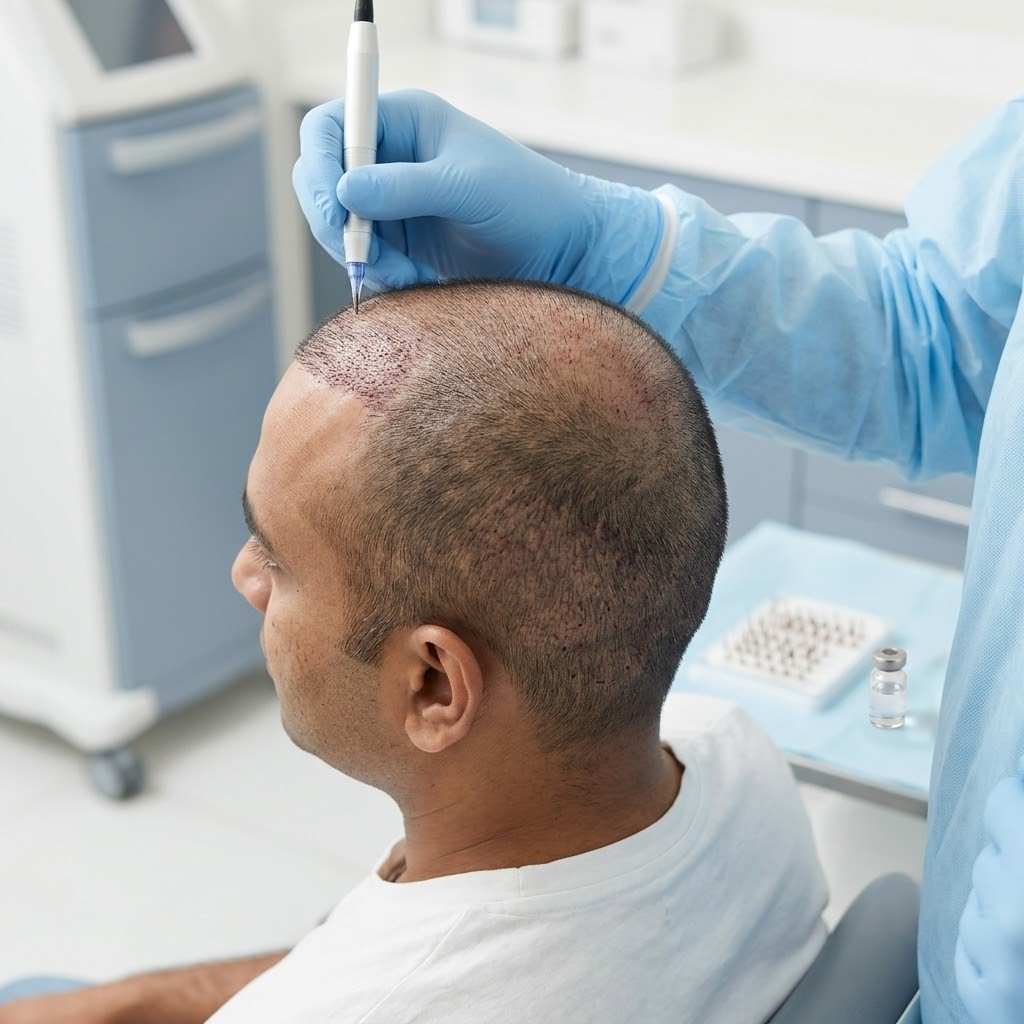
Tiny recipient sites are created throughout the upper lip according to the planned moustache design.
This stage is particularly demanding because moustache hairs naturally emerge almost parallel to the skin surface.
The surgeon carefully controls:
Hair direction.
Hair angle.
Hair orientation.
Hair spacing.
Density transitions.
Accurate placement is essential because even slight deviations can become noticeable once the moustache grows.
Step 5: Follicular Implantation
Each follicular unit is individually implanted into its designated recipient site.
Single-hair grafts are typically used along the upper border of the moustache to create soft, natural edges, while carefully selected grafts help build density throughout the central and lateral portions of the moustache.
Every implanted follicle is positioned to produce natural hair growth that can later be shaved, trimmed, waxed, or styled according to the patient's preference.
Does a Mustache Hair Transplant Leave a Scar?
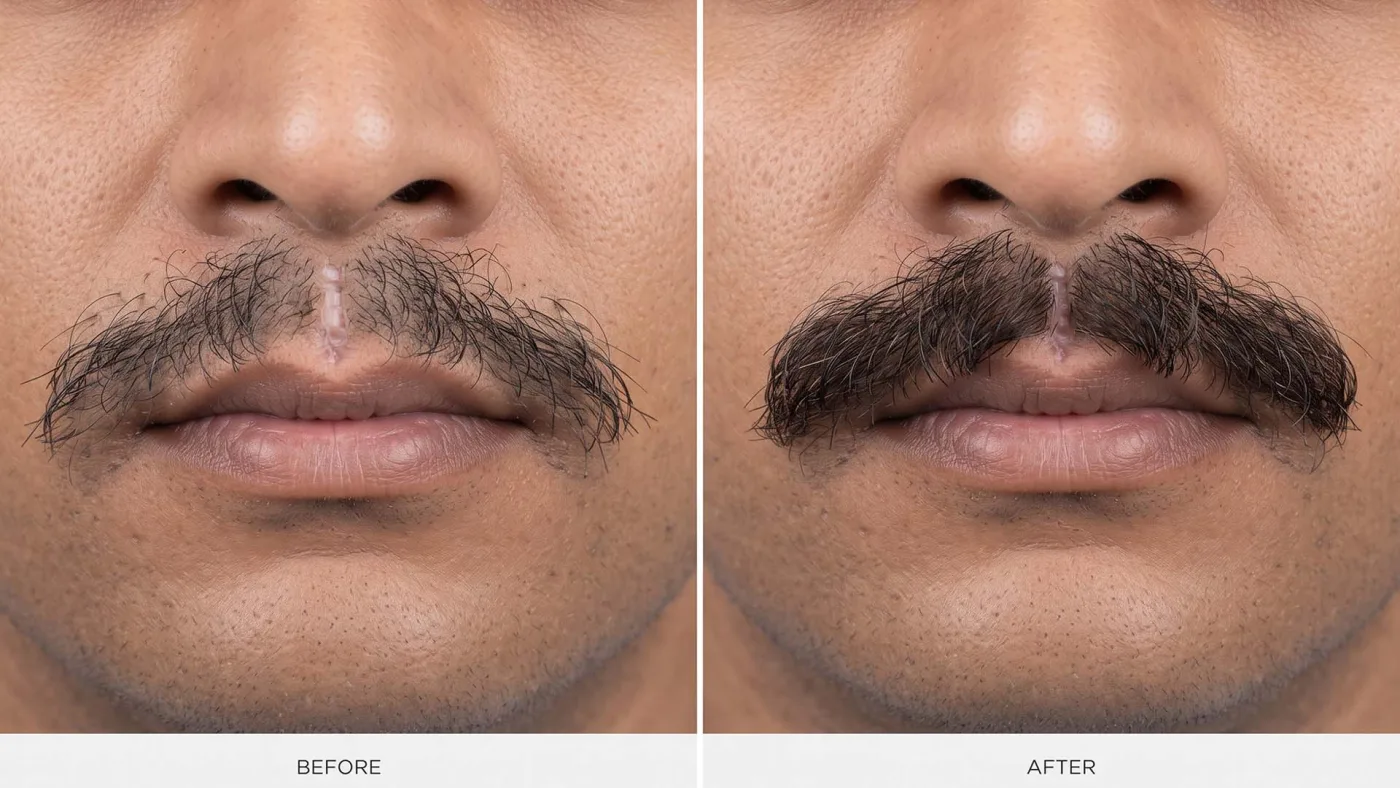
One of the major advantages of FUE-based moustache transplantation is that it does not create a linear donor scar.
Instead, individual follicular units are harvested through tiny circular extraction sites that gradually heal over time.
Once the surrounding scalp hair grows, these microscopic extraction sites are usually difficult to notice.
The visibility of donor marks depends on several factors, including:
Hair length.
Hair density.
Skin type.
Healing characteristics.
Number of grafts harvested.
Surgical technique.
The upper lip recipient area also develops tiny temporary crusts around each implanted follicle during healing. These naturally fall away as the skin recovers and should not be picked or removed prematurely.
What Results Can You Expect After a Mustache Hair Transplant?
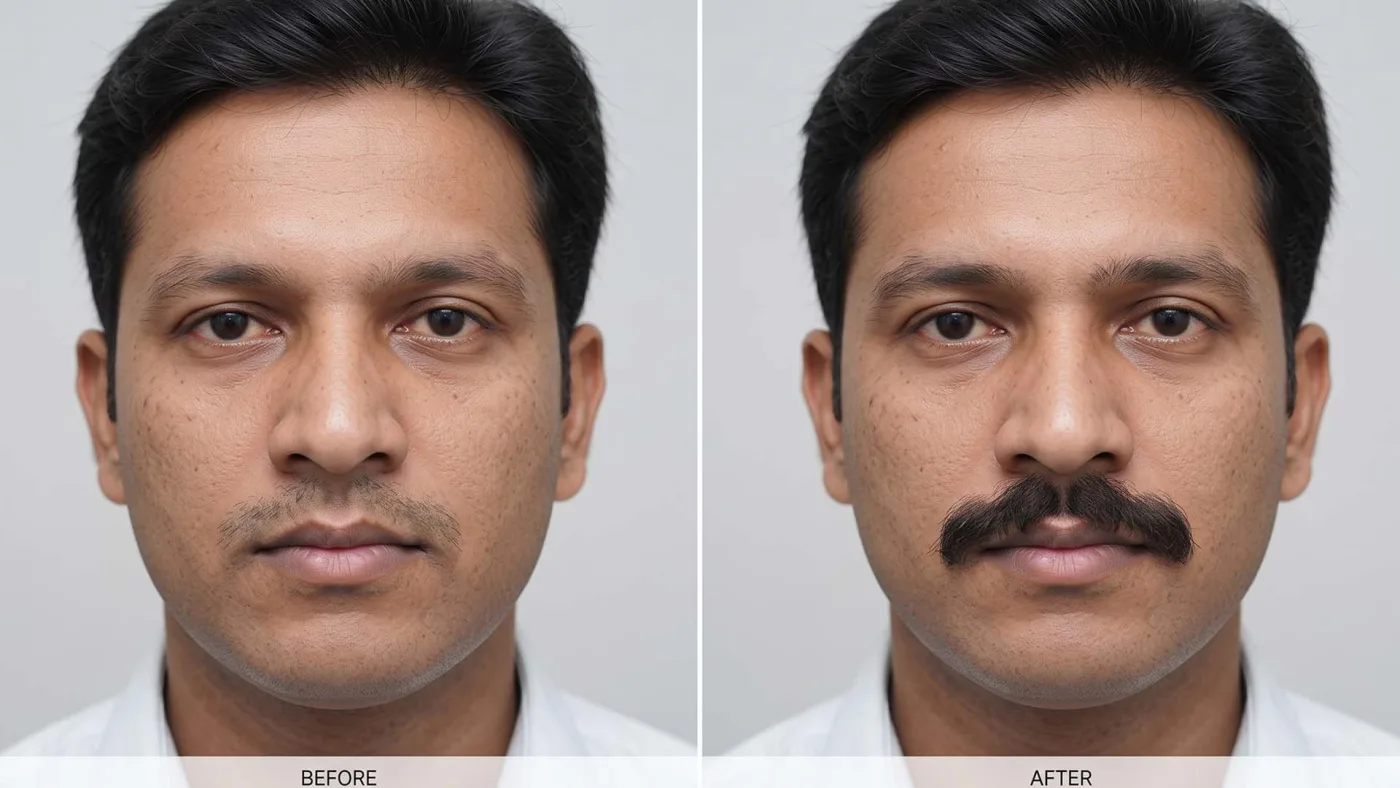
A Mustache Hair Transplant produces gradual improvements rather than immediate cosmetic changes.
Following surgery, the transplanted follicles remain securely positioned beneath the skin while the surrounding tissue begins healing.
During the first few weeks, many transplanted hairs naturally shed.
This temporary shedding, known as shock shedding, is a normal biological response and does not mean the transplanted follicles have been lost.
The follicles remain alive beneath the skin and gradually begin producing new moustache hair over the following months.
Patients commonly notice:
Fuller Mustache Density
Previously sparse or patchy areas gradually become denser as transplanted follicles mature.
Natural Hair Growth
Hair grows according to the carefully planned direction and angle, blending naturally with existing moustache hair.
Permanent Hair Growth
Because transplanted follicles retain the biological characteristics of the donor scalp, they continue producing hair for many years.
Improved Facial Balance
A well-designed moustache can enhance upper lip definition, improve facial symmetry, and contribute to overall facial aesthetics.
Normal Grooming
Once healing is complete, transplanted moustache hair can be shaved, trimmed, styled, and maintained just like naturally growing facial hair.
What Is Recovery Like After a Mustache Hair Transplant?
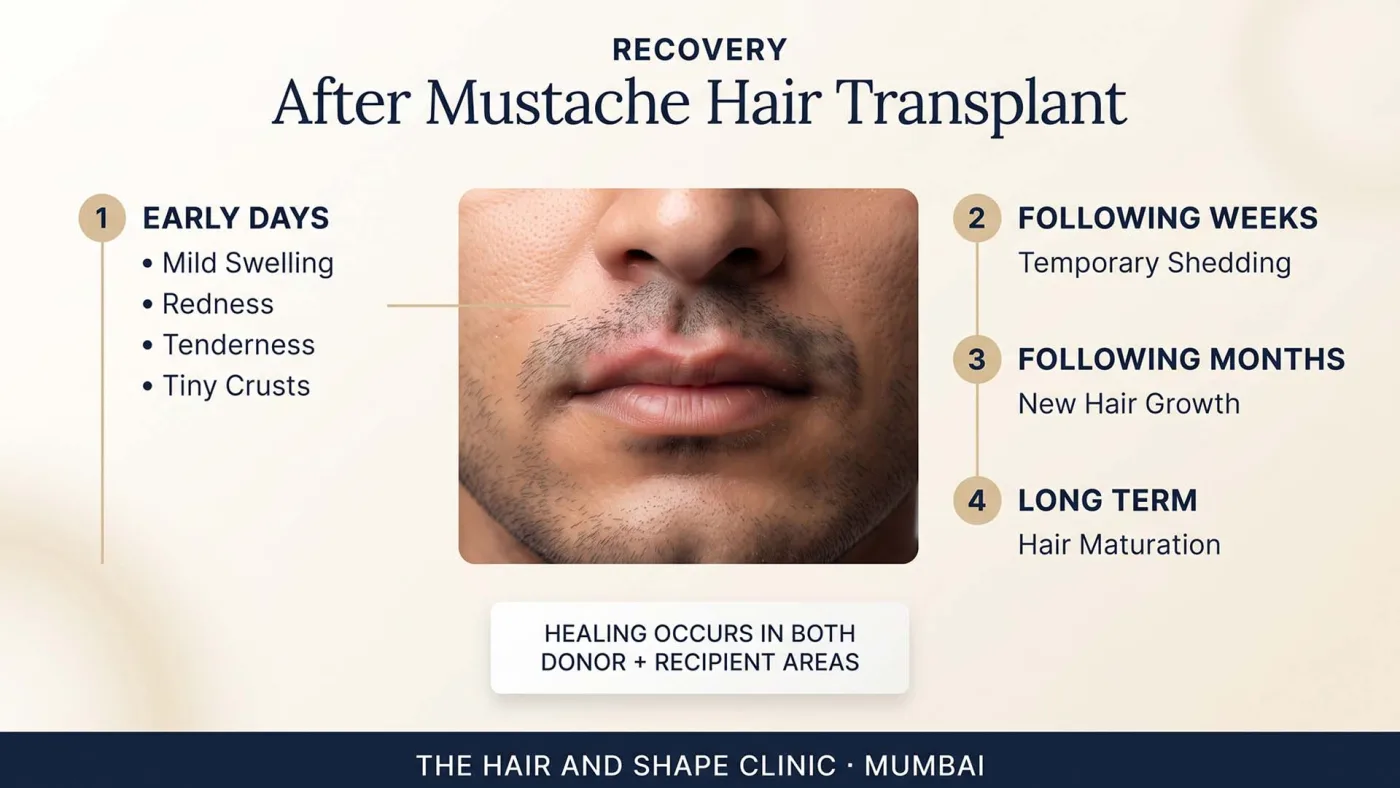
Recovery following a Mustache Hair Transplant is generally straightforward because the procedure is minimally invasive.
Patients commonly experience mild swelling, temporary redness, slight tenderness around the upper lip, and tiny crusts surrounding the implanted follicles.
These temporary changes gradually improve over the first several days as healing progresses.
Consultation & Facial Hair Assessment
Your facial anatomy, moustache pattern, donor characteristics, and cosmetic goals are carefully evaluated before treatment planning.
Mustache Hair Transplant Procedure
Healthy donor follicles are harvested, preserved, recipient sites are created, and individual grafts are implanted according to the personalized moustache design.
Early Healing
Both the donor scalp and upper lip begin healing while transplanted follicles establish a healthy blood supply.
Shock Shedding
Temporary shedding of transplanted hairs occurs during the normal healing process while the follicles remain viable beneath the skin.
New Hair Growth
New permanent moustache hairs gradually emerge over the following months.
Hair Maturation
The transplanted moustache continues becoming thicker, longer, and more natural as the follicles progress through normal hair growth cycles.
Are There Any Risks or Limitations?
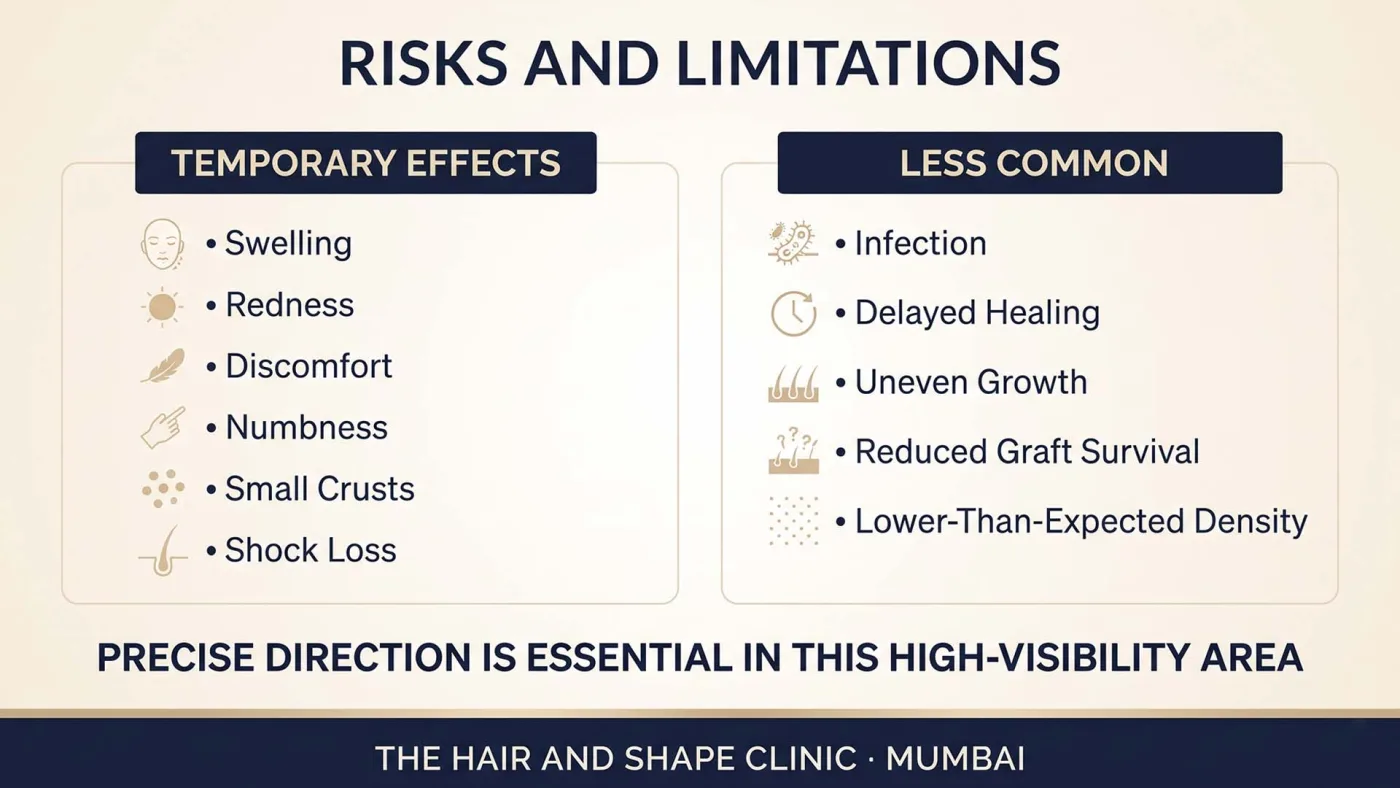
A Mustache Hair Transplant is considered a safe and predictable procedure when performed by experienced hair restoration surgeons.
Like every surgical procedure, however, it carries certain risks.
Temporary effects may include:
Mild swelling.
Temporary redness.
Minor discomfort.
Temporary numbness.
Small crust formation.
Temporary shock loss of nearby facial hair.
Less commonly, infection, delayed healing, uneven growth, reduced graft survival, or less-than-expected density may occur.
Because the moustache occupies such a prominent facial position, careful planning and precise follicular placement are particularly important to achieving a natural appearance.
How Much Does a Mustache Hair Transplant Cost in Mumbai?
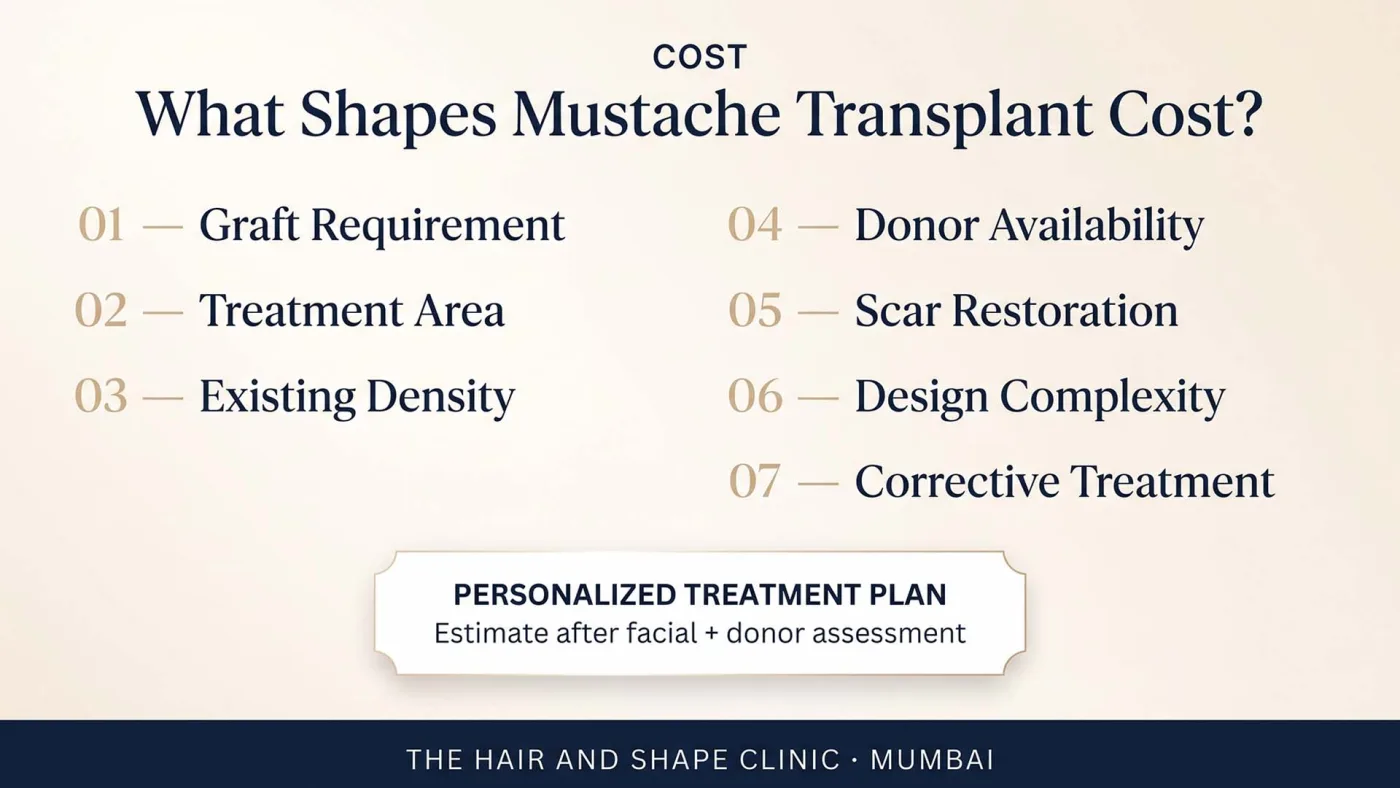
The cost of a Mustache Hair Transplant varies according to each patient's individualized treatment plan.
Several factors influence pricing, including:
Number of grafts required.
Size of the treatment area.
Existing moustache density.
Donor hair availability.
Presence of scars or previous facial surgery.
Complexity of moustache design.
Corrective procedures, if required.
Following a comprehensive consultation, your surgeon will recommend the appropriate number of grafts, discuss the expected outcome, explain the treatment plan, and provide a personalized cost estimate before scheduling the procedure.
Why Choose Hair & Shape for Mustache Hair Transplant?
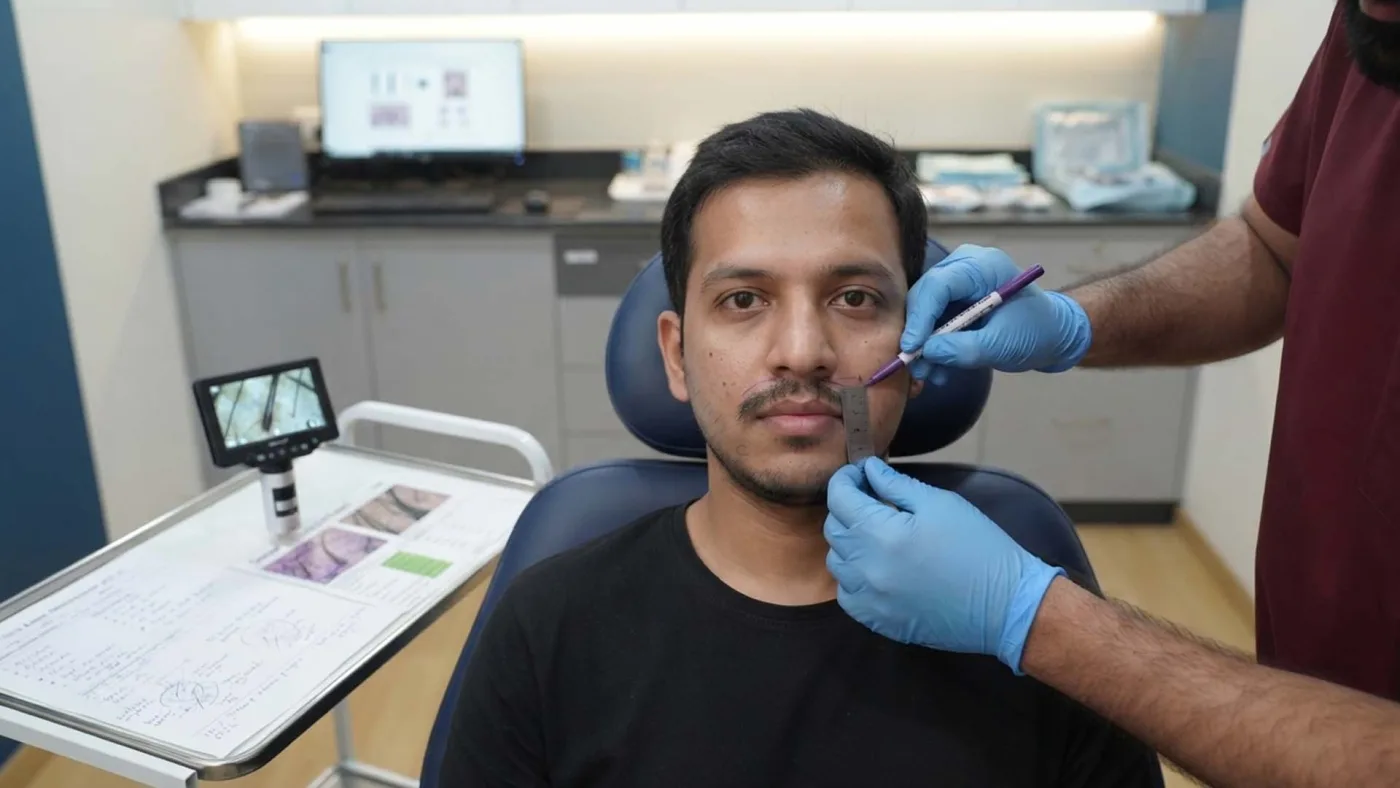
Restoring a natural-looking moustache requires much more than simply transplanting hair into the upper lip. It demands an understanding of facial aesthetics, hair growth patterns, donor hair selection, and meticulous microsurgical implantation.
At Hair & Shape Clinic, every moustache transplant begins with a detailed assessment of facial anatomy, upper lip contours, existing facial hair, donor quality, skin condition, and long-term aesthetic goals.
Rather than creating an artificial or excessively dense appearance, the emphasis is on restoring a moustache that blends naturally with your facial features and complements your overall appearance.
Why Does Personalized Mustache Planning Matter?
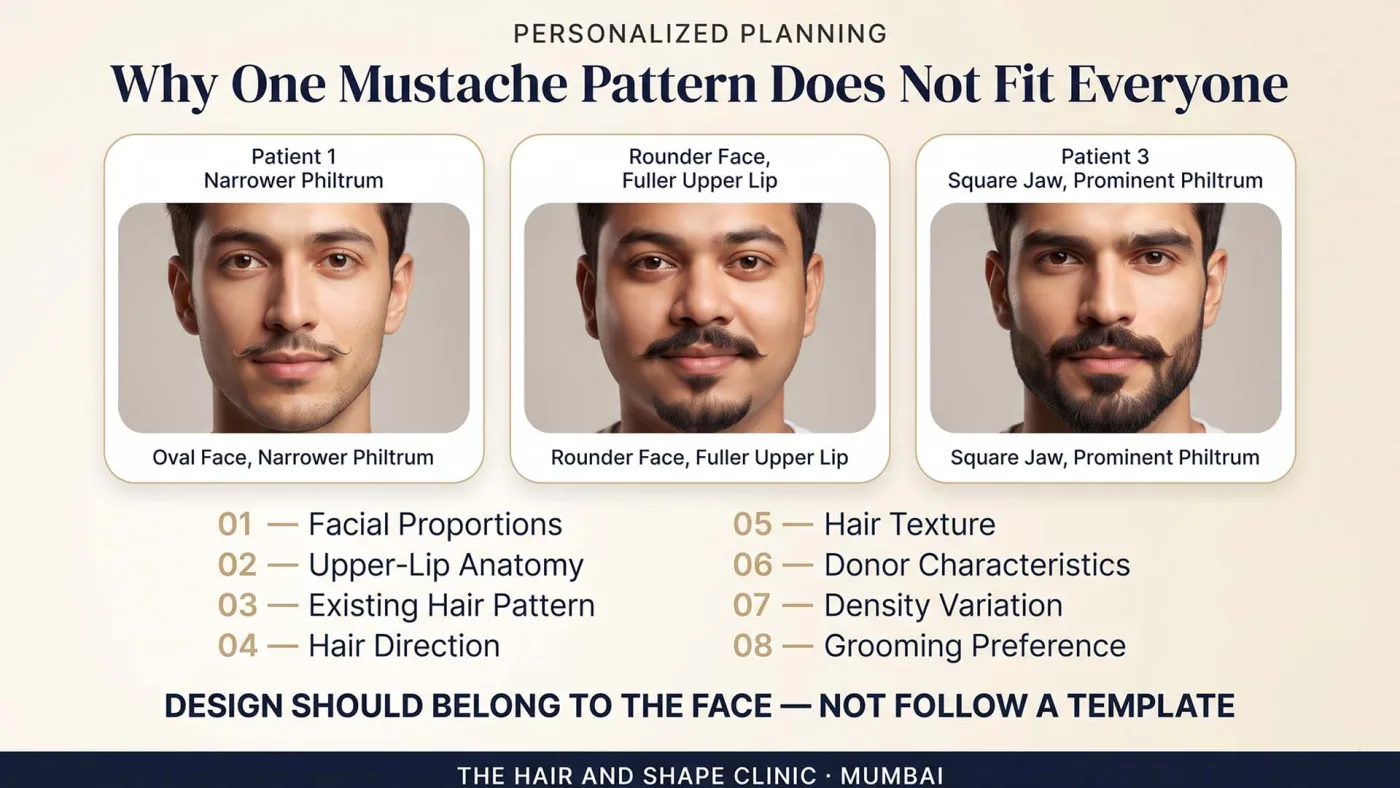
Every moustache is unique. Facial proportions, lip shape, hair texture, ethnic characteristics, and personal styling preferences all influence the ideal design.
Every Face Has Different Proportions
The moustache should enhance facial balance rather than follow a standard pattern.
Hair Direction Varies Across the Upper Lip
Different regions of the moustache naturally grow in different directions, making precise implantation essential.
Natural Density Is Not Uniform
Strategic variations in density create a more authentic and realistic appearance.
Donor Hair Selection Is Important
Choosing donor follicles with suitable characteristics helps achieve a moustache that blends seamlessly with existing facial hair.
Long-Term Appearance Should Be Considered
A well-planned moustache should continue looking natural regardless of hairstyle, beard style, or grooming preferences.
International Patients Seeking Mustache Hair Transplant in Mumbai
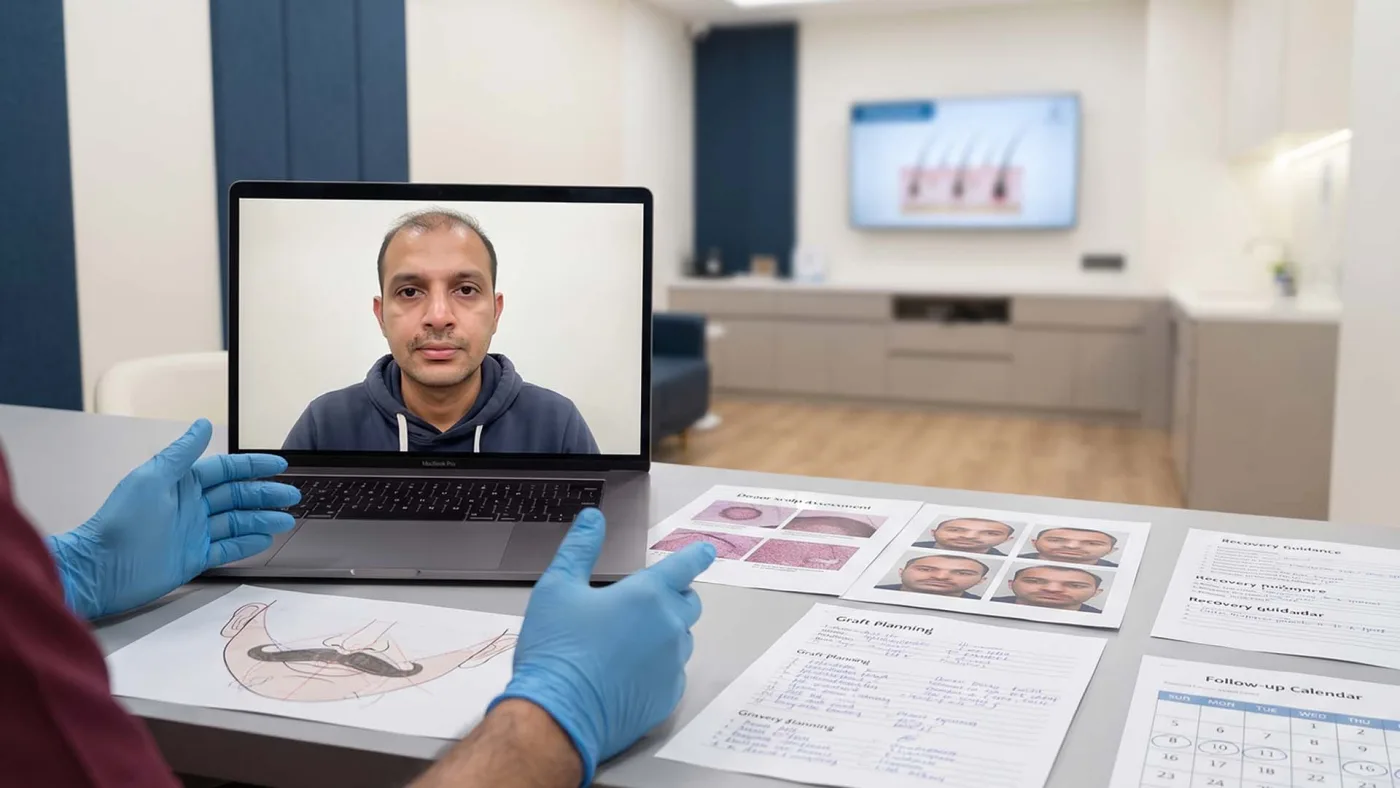
Hair & Shape Clinic welcomes patients from across India and around the world seeking advanced moustache restoration procedures.
Our international patient pathway is designed to simplify every stage of treatment, from the initial virtual consultation through postoperative follow-up after returning home.
Before You Travel
Virtual consultations, facial photographs, donor assessment, and medical history review help determine whether a Mustache Hair Transplant is the most appropriate treatment before your visit.
During Your Stay
Your treatment includes consultation, moustache design, follicular transplantation, postoperative care, and detailed recovery guidance tailored to your procedure.
Returning Home
Your moustache will continue developing over several months after transplantation. Ongoing guidance regarding healing, grooming, hair growth milestones, and long-term maintenance helps support the best possible outcome wherever you live.
What to Expect
Consultation
A detailed assessment of your goals, suitability, and a personalised plan.
Preparation
Clear pre-treatment guidance so you arrive fully prepared and at ease.
The Procedure
Your treatment, performed by our specialists with comfort and safety first.
Aftercare
Structured recovery support and follow-ups to protect your results.
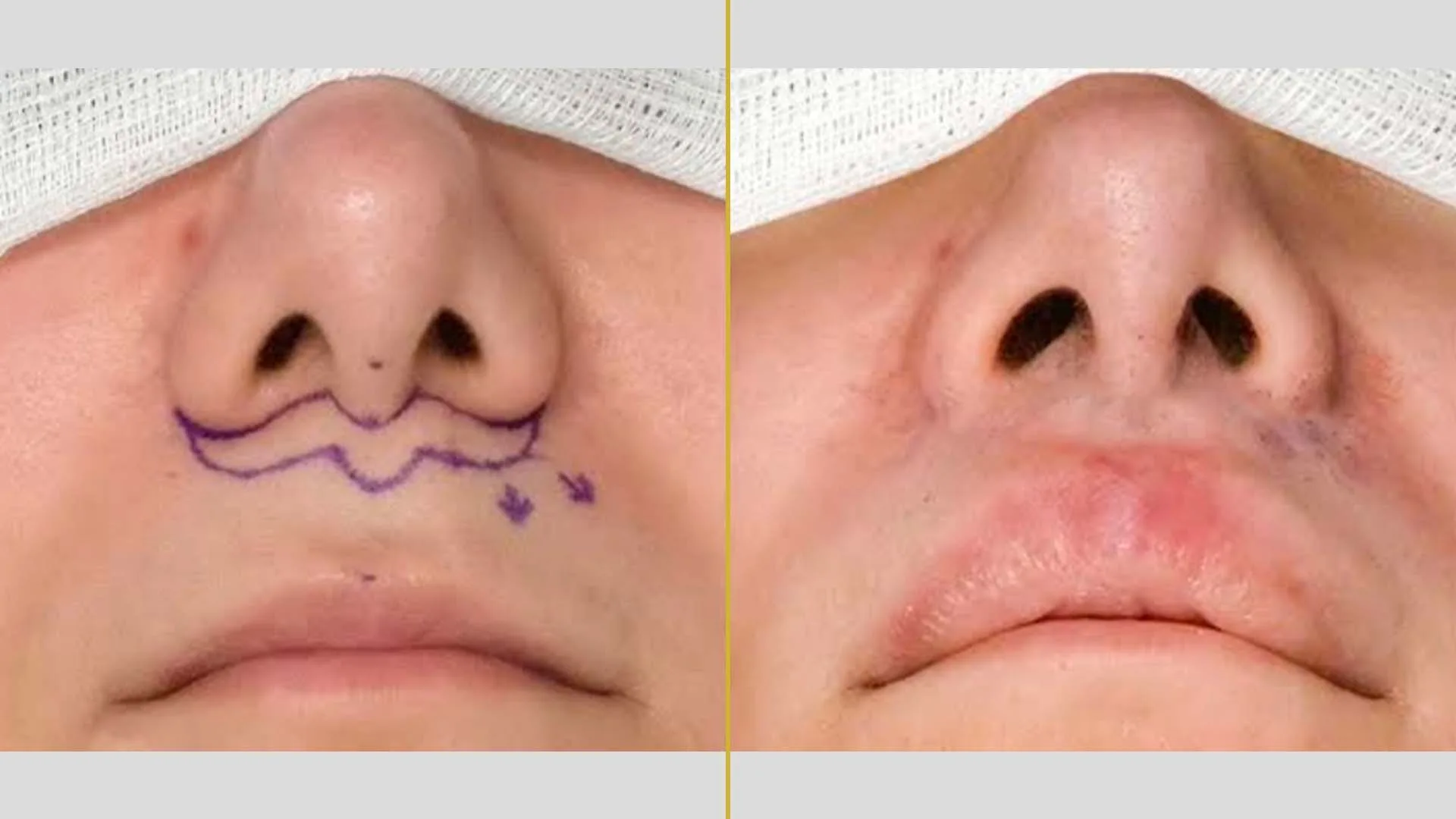
Before & After Transformations
Frequently Asked Questions
Everything you need to know about Mustache Hair Transplant. Still curious? Our team is one message away.
Can a mustache transplant be combined with a beard transplant?
Yes. Many patients choose to restore both the beard and mustache during a comprehensive facial hair restoration plan, depending on donor availability and treatment goals.
Can a mustache transplant hide scars?
In suitable cases, transplanted follicles may help reduce the visibility of scars by introducing natural hair growth into the affected area. Suitability depends on scar quality and individual assessment.
When will I see the final results?
Early growth usually begins around 3 to 4 months after the procedure. Full density and maturation commonly develop between 9 and 12 months.
How long does recovery take?
Initial healing generally occurs within the first week. Temporary shedding is expected before new growth begins, with visible improvement developing gradually over several months.
Can I shave or trim my transplanted mustache?
Yes. Once healing is complete and the transplanted follicles have fully established themselves, the mustache can be shaved, trimmed, and groomed just like natural facial hair.
Where does the donor hair come from?
Donor follicles are usually harvested from the back or sides of the scalp, where hair closely matches the texture and characteristics needed for facial hair restoration.
Will the transplanted mustache look natural?
When planned with proper density, direction, and facial proportions, a mustache transplant blends naturally with existing facial hair and is designed to appear indistinguishable from naturally growing hair.
Is a mustache transplant permanent?
Yes. The transplanted hair follicles are typically taken from the scalp and retain their natural growth characteristics after transplantation. Once established, they continue growing like normal facial hair.
Begin Your Mustache Hair Transplant Journey
Book a consultation today and let our specialists craft a plan built entirely around you.