Is A Carbon Peel Painful? What Does The Treatment Actually Feel Like?
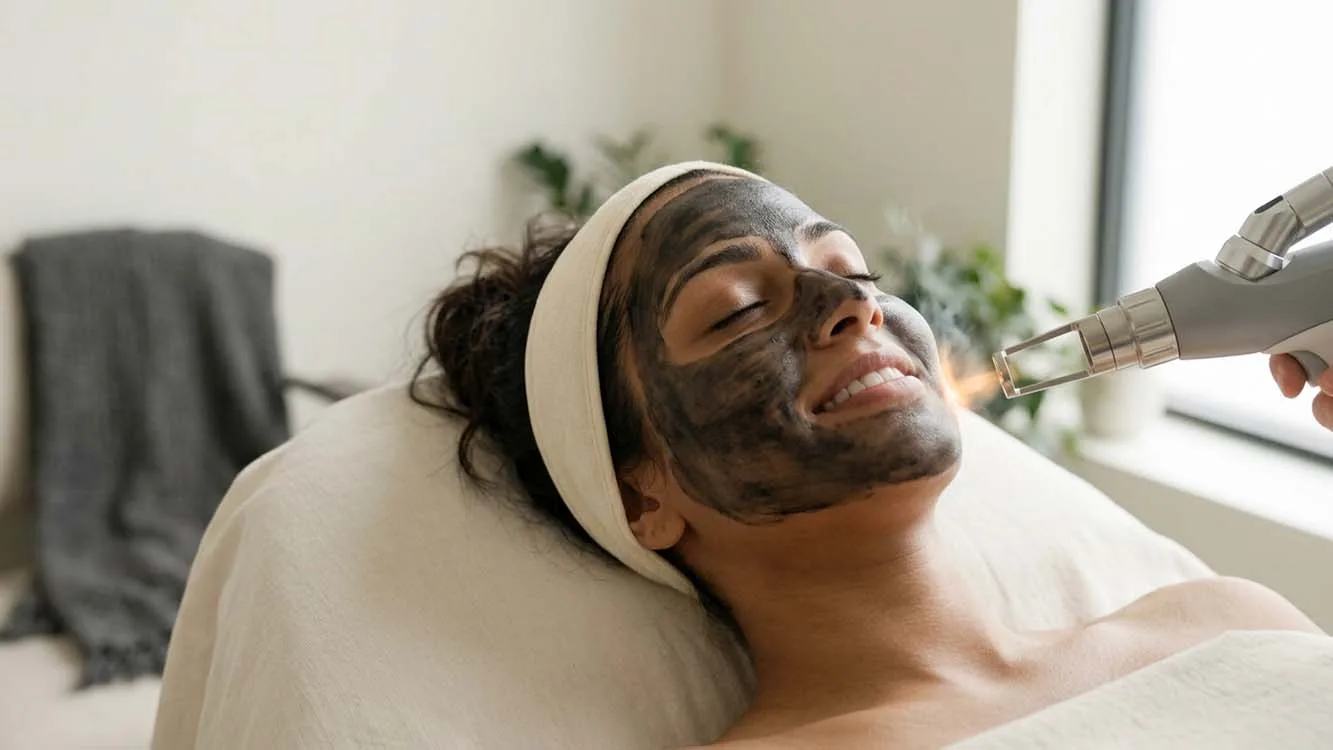
How Long Does A Carbon Peel Take?
A routine carbon peel commonly fits within a relatively short appointment, but the total duration depends on the protocol.
The appointment may include time for:
Skin assessment
Cleansing
Removal of makeup and sunscreen
Carbon application
Drying of the carbon layer
Laser passes
Cooling
Moisturiser
Sun protection
Aftercare guidance
A simple session may take approximately 30–45 minutes, while combined protocols may take longer.
Treatment should not be rushed simply because it is marketed as a lunchtime facial. The carbon layer needs to be applied evenly, the skin response should be monitored and the laser should be delivered with controlled coverage.
What Does The Skin Feel Like Immediately After A Carbon Peel?
Immediately after treatment, the skin may feel:
Warm
Slightly tight
Mildly sensitive
Smooth
Dry in selected areas
Similar to mild sun exposure
The face may appear:
Lightly pink
Temporarily brighter
Less oily
Slightly flushed
Mildly swollen around active acne lesions
These effects are generally temporary after a conservative treatment.
Some patients notice almost no visible redness, while others remain flushed for several hours. Skin sensitivity, energy settings, number of passes and pre-existing inflammation all influence the response.
Clinical research on carbon-assisted Q-switched Nd:YAG treatment in skin of colour has reported mainly mild, short-lived reactions, although individual outcomes and treatment protocols vary.
Is There Downtime After A Carbon Peel?
Most patients experience limited downtime after a routine carbon peel.
Many can return to ordinary activities on the same day, although the skin may temporarily look pink or feel sensitive.
Possible short-term effects include:
Mild redness
Dryness
Tightness
Temporary warmth
Slight sensitivity
Mild flaking
Temporary acne-like bumps
Increased reaction to active skincare products
Downtime may be greater when:
Stronger settings are used
Multiple laser passes are performed
The skin was already irritated
Carbon peel is combined with another treatment
Active inflammatory acne is present
The patient develops a pigment response
Post-treatment instructions are not followed
“Minimal downtime” should not be interpreted as permission to expose recently treated skin immediately to strong sunlight, heat, scrubbing or irritating products.
Can You Wash Your Face After A Carbon Peel?
Gentle cleansing is generally possible after treatment, but the exact timing should follow the instructions provided for the specific protocol.
When washing the face, patients should usually avoid:
Hot water
Rough washcloths
Facial brushes
Scrubs
Strong foaming cleansers
Fragranced products
Repeated rubbing
Picking at dry areas
A mild cleanser and lukewarm water are usually more comfortable.
The skin should be patted dry rather than rubbed forcefully.
If the face feels unusually hot, painful or raw, further products should not be layered repeatedly without assessment.
Which Products Can Be Used After A Carbon Peel?
Post-treatment skincare should usually focus on protecting the skin barrier.
A simple routine may include:
Gentle cleanser
Fragrance-free moisturiser
Broad-spectrum sunscreen
Lip moisturiser when needed
Other products specifically advised for the patient
Strong active products may need to be paused temporarily.
These can include:
Retinoids
Glycolic acid
Salicylic acid
Lactic acid
Scrubs
Peeling solutions
Benzoyl peroxide
Strong vitamin C formulations
Alcohol-based toners
Bleaching creams
Unregulated combination creams
The restart timing depends on how the skin looks and feels.
A person whose skin is calm the next day may follow a different plan from someone experiencing persistent redness, dryness or irritation.
Why Is Sunscreen Important After Treatment?
Laser-treated skin may temporarily become more sensitive to ultraviolet and visible-light exposure.
Sun exposure can increase the likelihood of:
Redness
Irritation
Tanning
Uneven pigmentation
Post-inflammatory hyperpigmentation
Recurrence or worsening of pigmentation concerns
Patients should generally use broad-spectrum sunscreen and reduce unnecessary direct exposure.
Additional protection may include:
Shade
A wide-brimmed hat
Avoiding peak sunlight
Reapplying sunscreen when outdoors
Avoiding prolonged travel beside an uncovered vehicle window
Limiting outdoor heat during early recovery
Sunscreen is especially important in Mumbai, where incidental exposure can occur during commuting even when a person is not intentionally spending time outdoors.
Can Makeup Be Applied After A Carbon Peel?
Makeup may be possible relatively soon after a mild session, but it is preferable to allow the skin to settle when possible.
Applying makeup immediately may be uncomfortable if the skin is:
Warm
Red
Tight
Dry
Irritated
Slightly swollen
Heavy, fragranced or occlusive makeup may also aggravate acne-prone skin.
When makeup is resumed, patients should use:
Clean brushes or applicators
Non-irritating products
Gentle removal methods
Products that have not caused previous reactions
Makeup should not be used to hide blistering, burns or an unexpected skin reaction instead of seeking assessment.
Can You Exercise After A Carbon Peel?
Strenuous exercise may need to be limited briefly after treatment.
Heavy exercise can increase:
Facial heat
Sweating
Redness
Stinging
Friction
Irritation around active acne
The recommended restriction depends on how strongly the skin reacted.
Gentle daily movement is different from:
Intense gym training
Hot yoga
Running in direct sunlight
Sauna use
Steam rooms
Swimming
A patient whose face remains hot or flushed should allow it to settle before returning to heat-intensive exercise.
Can You Take A Hot Shower Or Use Steam After Treatment?
Hot showers, facial steaming, saunas and steam rooms can intensify heat and redness after laser treatment.
During early recovery, excessive heat may cause:
Increased flushing
Burning
Prolonged sensitivity
Greater inflammation
Worsening of rosacea-prone skin
Lukewarm water is generally more comfortable.
Steam should not be used to “open the pores” after a carbon peel. Pores do not need to be forced open, and additional heat can irritate freshly treated skin.
Can A Carbon Peel Cause Breakouts?
Some patients notice temporary bumps or acne-like eruptions after treatment.
Possible reasons include:
Existing microcomedones becoming more visible
Skin irritation
Occlusive aftercare products
Sweat and friction
Follicular inflammation
Reaction to the carbon formulation
Changes in the usual acne routine
A mild temporary eruption may settle, but persistent or painful breakouts should be assessed.
The patient should avoid:
Squeezing the lesions
Applying multiple strong spot treatments
Scrubbing the skin
Repeating the carbon peel immediately
Starting unprescribed antibiotics or steroid creams
A breakout after treatment does not automatically mean toxins are being “purged” from the skin. It may represent irritation, acne activity or folliculitis.
Can A Carbon Peel Make Acne Worse?
Yes, acne may occasionally appear more inflamed after treatment, particularly when the skin was unsuitable or already unstable.
Possible contributing factors include:
Treating broken or squeezed lesions
Excessive heat
Incorrect settings
Irritating aftercare
Stopping effective acne medication unnecessarily
Heavy cosmetic products
Follicular inflammation
An inaccurate diagnosis
Carbon-assisted Q-switched Nd:YAG treatment has shown improvement in acne in some small studies, but this does not make it a universal first-line treatment for every acne type. Evidence is still limited by study size, differing protocols and relatively short follow-up periods.
Severe inflammatory, nodular or scarring acne may require a broader medical treatment plan rather than repeated cosmetic facials alone.
Can A Carbon Peel Reduce Oily Skin?
Some patients notice temporary reduction in surface oiliness after treatment.
The effect may relate to:
Removal of superficial oil
Reduction of follicular debris
Temporary changes in sebum activity
Exfoliation of the skin surface
Improvement in inflammatory acne activity
The result is not necessarily permanent.
Oil production is influenced by:
Hormones
Genetics
Climate
Skincare products
Acne medication
Stress
Age
Mumbai’s humid weather may also make the skin feel oily even when actual sebum production has not changed significantly.
Carbon peel should not be presented as permanently switching off the sebaceous glands.
Can A Carbon Peel Permanently Shrink Pores?
No treatment can permanently close or erase pores.
Pores may look smaller temporarily when:
Surface oil is reduced
Debris is cleared
The surrounding skin appears smoother
Mild swelling tightens the surface temporarily
Light reflection becomes more even
Pore visibility is influenced by:
Genetics
Sebum production
Hair follicles
Acne
Skin elasticity
Sun damage
Ageing
Carbon peel may improve the appearance of selected enlarged-looking pores, but the degree and duration of improvement vary.
Claims of permanently closing pores are medically unrealistic.
Can A Carbon Peel Remove Blackheads?
A carbon peel may reduce some superficial congestion, but it does not guarantee complete blackhead removal.
Blackheads form when material within the follicle becomes exposed to air and oxidises.
Management may also require:
Appropriate cleansing
Salicylic acid
Topical retinoids
Comedone extraction in selected cases
Acne control
Reduction of heavy occlusive products
Deep or persistent comedones may not disappear after one carbon peel.
Aggressive squeezing immediately after laser treatment can increase inflammation and pigmentation.
Can A Carbon Peel Treat Acne Scars?
A carbon peel may improve superficial texture or temporary skin brightness, but it is unlikely to correct deep acne scars substantially.
Acne scars can include:
Ice-pick scars
Boxcar scars
Rolling scars
Raised scars
Post-acne pigmentation
Post-acne redness
These concerns do not respond identically.
Deep structural scars may require treatments such as:
Subcision
Microneedling
Fractional resurfacing
TCA CROSS
Scar revision
Combination therapy
The appropriate treatment depends on scar type, skin tone and risk of pigmentation.
A carbon peel should not be marketed as equivalent to deep scar-remodelling procedures.
Can A Carbon Peel Treat Pigmentation?
It may improve selected superficial unevenness, but pigmentation must first be diagnosed correctly.
Dark patches may represent:
Post-acne pigmentation
Tanning
Freckles
Melasma
Irritation
Lichen planus pigmentosus
Contact dermatitis
Drug-related pigmentation
Another skin condition
These conditions require different management.
Repeated laser treatment without diagnosis may worsen some pigment disorders, particularly when heat or inflammation stimulates further melanin production.
Melasma, in particular, can be recurrent and sensitive to heat, sunlight and hormonal factors. A temporary brightening response does not necessarily mean the condition has been permanently treated.
Can Carbon Peel Make Pigmentation Worse?
Yes. Any treatment that creates inflammation can potentially trigger post-inflammatory hyperpigmentation, especially in medium and deeper Indian skin tones.
The risk may increase with:
Excessive energy
Multiple overlapping passes
Recent tanning
Sun exposure after treatment
Active dermatitis
Picking or scrubbing
Previous pigment complications
Using strong skincare products too soon
Treating an unsuitable pigmentation condition
Pigmentation may appear days after the initial redness has settled.
Patients should report:
New dark patches
Rectangular treatment marks
Persistent redness
Uneven lightening
Crusting
Blistering
Further treatment should generally be delayed until the reaction has been assessed.
Can A Carbon Peel Cause Burns?
Although uncommon with appropriate patient selection and technique, burns are possible.
A burn may occur because of:
Excessive laser energy
Repeated pulse overlap
Inadequate cooling
Uneven carbon application
Treating recently tanned skin
Treating irritated or damaged skin
Incorrect device parameters
Poor technique
Failure to respond to excessive pain
Possible signs include:
Severe burning
Persistent intense pain
Blistering
Grey or white skin change
Dark crusting
Open skin
Rapid swelling
These findings are not part of a normal “deep cleansing” process.
Prompt assessment can help reduce the risk of infection, scarring and long-term pigment change.
What Should You Do If The Skin Burns After A Carbon Peel?
The first step is to stop further heat and irritation.
The patient should:
Contact the treating service promptly
Avoid picking or removing blistered skin
Avoid home remedies
Avoid lemon, toothpaste or harsh antiseptics
Avoid self-prescribed steroid combinations
Protect the area from sunlight
Follow medical wound-care advice
Treatment depends on the depth and appearance of the injury.
A minor superficial reaction may require cooling and barrier support, while blistering or open skin may need more structured care.
Delaying assessment can increase the likelihood of pigmentation or scarring.
Can Carbon Peel Cause Hypopigmentation?
Hypopigmentation refers to an area becoming lighter than the surrounding skin.
It may occur if laser energy affects pigment-producing cells.
The risk may be greater with:
Excessive settings
Repeated treatments at short intervals
Previous burns
Aggressive laser toning protocols
Deeper skin tones
Poor healing
The change may be temporary or persistent.
A lighter patch should be evaluated before another session is performed.
Continuing treatment over an area already showing pigment loss may make the contrast more noticeable.
How Many Carbon-Peel Sessions Are Needed?
There is no universal session number.
The plan depends on:
Primary skin concern
Acne severity
Oiliness
Skin sensitivity
Pigmentation tendency
Response to the first session
Other treatments being used
Realistic treatment goals
Some patients seek one session for temporary surface smoothness before an event. Others may undergo a short series for acne or oil-related concerns.
A package should not be completed automatically when:
The skin is not improving
Breakouts are worsening
Pigmentation develops
Pain is increasing
The diagnosis is uncertain
Another treatment would be more appropriate
Progress should be assessed between sessions rather than judging success only from immediate brightness.
How Soon Can A Carbon Peel Be Repeated?
The interval should allow the skin to return to its normal baseline.
Repeating treatment too soon may increase:
Irritation
Dryness
Barrier damage
Redness
Pigmentation
Sensitivity to skincare products
The appropriate interval depends on:
Laser settings
Number of passes
Skin reaction
Treatment purpose
Combined procedures
Individual healing
A patient whose skin remains dry or inflamed should not undergo another session simply because a standard package schedule says it is due.
How Long Do Carbon-Peel Results Last?
The duration varies according to the concern being treated.
Immediate effects such as reduced surface oil and smoother texture may be temporary.
Longer-term improvement may depend on:
Number of sessions
Acne treatment
Home skincare
Sun protection
Hormonal influences
Climate
Sebum production
Continued exposure to irritating products
A carbon peel does not stop ageing, acne recurrence or future tanning.
Maintenance should be considered only when the patient previously benefited and the skin remains suitable for treatment.
Can Carbon Peel Be Done Before A Wedding Or Important Event?
A carbon peel is sometimes chosen before an event because downtime is often limited.
However, a first session should not be scheduled immediately before an important occasion.
An unexpected response may include:
Redness
Dryness
Breakouts
Pigmentation
Swelling
Irritation
A patient who has never undergone the treatment should allow enough time to observe how their skin responds.
The procedure should also not be used as a last-minute attempt to treat severe acne, deep scars or long-standing pigmentation.
Temporary brightness is different from meaningful correction of a medical skin condition.
Can Carbon Peel Be Combined With Other Treatments?
It may be combined with selected procedures, but combining treatments can increase skin stress.
Possible combinations may involve:
Laser toning
Acne treatment
Superficial peels
Hydrating facials
Other non-ablative devices
The sequence and interval matter.
Performing too many treatments together can increase:
Burning
Dryness
Redness
Barrier disruption
Pigmentation
Difficulty identifying which procedure caused a reaction
Combination treatment should have a clear clinical purpose rather than being added merely to make a package appear more advanced.
Who Should Avoid Or Carefully Reconsider Carbon Peel?
Carbon peel may be unsuitable or require further assessment for patients with:
Active skin infection
Open wounds
Severe dermatitis
Uncontrolled rosacea
Active herpes
Significant photosensitivity
Recent sunburn
Fresh tanning
Previous severe laser reaction
Unexplained pigmentation
Active blistering acne lesions
A history of abnormal scarring
Inability to follow sun-protection advice
Unrealistic expectations
Patients should also disclose:
Pregnancy
Breastfeeding
Current medicines
Isotretinoin history
Recent chemical peels
Recent waxing or threading
Previous laser treatment
Allergies
Past pigmentation after procedures
Suitability depends on the complete clinical context, not only on whether the patient wants a brighter appearance.
Which Symptoms Require Prompt Assessment After A Carbon Peel?
Medical review is important when the patient develops:
Severe or increasing pain
Persistent burning
Blistering
Open wounds
Dark crusting
Rapidly increasing swelling
Pus or discharge
Fever
Spreading redness
New dark geometric marks
New pale patches
Eye pain or visual symptoms
A rash extending beyond the treated area
Mild warmth and temporary redness may be expected, but worsening symptoms should not be dismissed as the treatment “working deeply.”
Common Myths About Carbon Peel
“Carbon Peel Must Hurt To Work”
Severe pain does not indicate better results. It may indicate excessive heat or skin injury.
“The Popping Sound Means The Skin Is Burning”
The sound usually comes from the laser fragmenting carbon particles.
“Carbon Peel Permanently Closes Pores”
Pores cannot be permanently erased or sealed.
“One Session Permanently Stops Oily Skin”
Oil production is influenced by hormones, genetics and skincare and may return.
“Carbon Peel Removes Deep Acne Scars”
It may improve surface texture but does not replace treatments designed for structural scars.
“Carbon Peel Is Safe For Every Pigmentation Problem”
Some pigment conditions can worsen after heat or inflammation.
“There Is No Downtime At All”
Many patients experience minimal downtime, but redness, dryness, breakouts or sensitivity may occur.
“Darker Indian Skin Cannot Undergo Carbon Peel”
Selected deeper skin tones may be treated, but parameters and skin condition require careful assessment.
“A Stronger Setting Always Gives A Better Glow”
Higher energy may increase burns and pigmentation without creating a better cosmetic result.
Why Personalised Carbon-Peel Planning Matters
The same carbon-peel protocol should not be applied to every patient.
Personalised assessment considers:
Skin tone
Current tanning
Barrier health
Acne type
Oiliness
Pigmentation diagnosis
Sensitivity
Previous reactions
Active skincare products
Medicines
Upcoming events
Realistic treatment goals
The correct plan may involve:
Conservative settings
A patch test
Temporary adjustment of skincare
Medical acne treatment first
Postponement until irritation settles
A different procedure
Avoiding laser treatment altogether
The objective should be meaningful improvement with controlled skin exposure—not creating the strongest possible snapping sensation or most dramatic immediate redness.
Why Choose Hair & Shape For Carbon-Peel Planning In Mumbai?
At Hair & Shape Clinic, carbon-peel planning begins with determining whether the treatment matches the patient’s actual skin concern.
The assessment may include:
Skin tone and tanning
Acne type and severity
Skin sensitivity
Barrier damage
Pigmentation pattern
Previous laser response
Current skincare products
Medicines
History of post-inflammatory pigmentation
Expectations about pores, scars and oiliness
Timing before social events
Patients should receive clear guidance about:
The expected snapping and warmth
Temporary redness
Sun protection
Product restrictions
Acne management
Possible pigmentation
When treatment should be postponed
When another procedure may be more suitable
The aim is a controlled, tolerable treatment selected for the right indication rather than presenting carbon peel as a universal facial for every skin problem.
Final Thoughts
A properly performed carbon peel is usually associated with mild warmth, tingling and brief snapping rather than severe pain.
The carbon layer itself generally feels cool or slightly tight. The popping sound and faint burnt smell occur as laser energy interacts with the carbon particles and can seem more dramatic than the physical sensation.
Pain may be greater when the skin is irritated, recently exfoliated, sun-exposed, inflamed or treated with unsuitable settings. Intense burning, persistent pain, blistering or visible skin injury should never be considered a normal part of treatment.
Carbon peel may help selected patients with oily skin, superficial congestion and mild acne, but it cannot permanently close pores, cure every form of acne or remove deep scars.
Medium and deeper Indian skin tones may be treated, but careful wavelength selection, conservative settings, sun protection and assessment of pigmentation risk remain essential.
The safest carbon peel should feel controlled and tolerable. Greater pain does not mean greater benefit.
Keep reading
Breast Augmentation: Complete Guide To Breast Enhancement Procedure, Recovery & Results
Breast Augmentation is a cosmetic breast surgery procedure designed to enhance breast volume, improve symmetry, and restore lost fullness using implants or fat transfer techniques. This guide explains breast augmentation types, procedure steps, implant options, recovery timeline, benefits, candidate suitability, and the importance of choosing an experienced plastic surgeon at Hair & Shape Clinic, Mumbai.

Fat Transplant: Complete Guide To Fat Transfer Procedure, Recovery & Results
Fat Transplant, also known as Fat Transfer or Autologous Fat Grafting, is an aesthetic procedure that uses a person's own fat to restore volume, improve contours, and create natural-looking enhancement. This guide explains the fat transfer procedure, treatment areas, benefits, recovery timeline, candidate suitability, and the importance of choosing an experienced plastic surgeon at Hair & Shape Clinic, Mumbai.
Lip Augmentation/Reduction: Complete Guide To Lip Surgery, Recovery & Results
Lip Augmentation and Lip Reduction are aesthetic procedures designed to improve lip volume, shape, symmetry, and facial balance. This guide explains lip enhancement and reduction techniques, procedure steps, recovery timeline, benefits, candidate suitability, and the importance of choosing an experienced plastic surgeon at Hair & Shape Clinic, Mumbai.